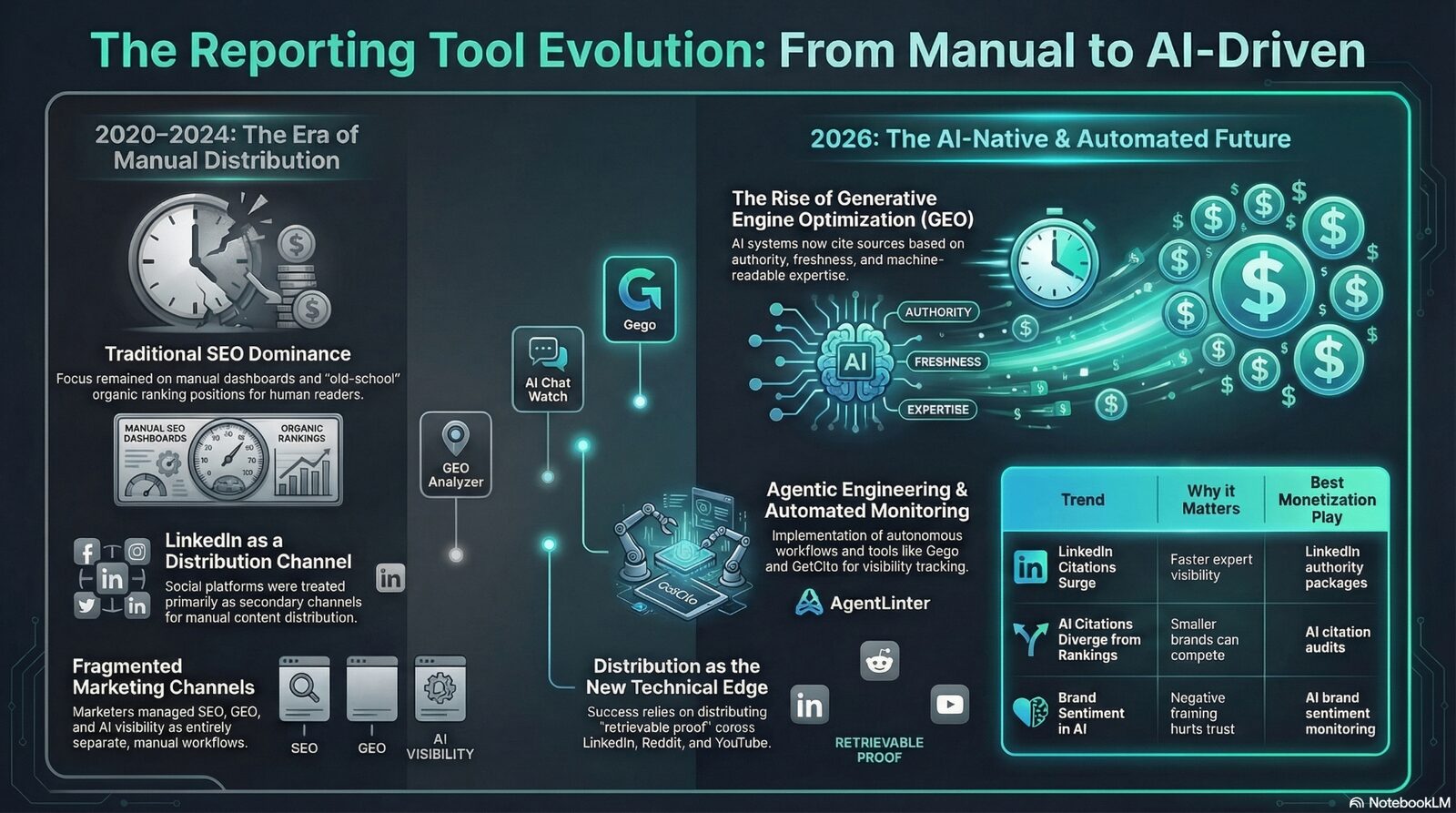
Bestie, listen: the SEO game we grew up with is officially over. We've reached a point where AI search is moving significantly faster than the documentation can keep up with. If you're still obsessing over traditional blue-link rankings while ignoring how Large Language Models (LLMs) perceive your brand, you're already behind.
In this new era, appearing on page one is no longer the win—being the source that AI systems "trust enough to cite" is. Welcome to the age of Generative Engine Optimization (GEO). To stay relevant, you need a visibility playbook built on two pillars: machine-readable authority and broad distribution across high-authority layers like LinkedIn and Substack. We're moving away from the old-school silo and toward a clean, distributed aesthetic of expertise. Let's get into the weeds of the five tools every lone-wolf strategist needs to own this shift.
Why These 5 Tools Matter Right Now
- ●AI search engines now process over 400 million queries per week
- ●LLM traffic grew 527% year-over-year (SeoProfy, March 2026)
- ●Brands are 6.5x more likely to be cited through third-party sources than their own domain
- ●Google AI Overviews reach over 2 billion monthly users
- ●LinkedIn has surged to the #1 cited domain for professional queries across major AI platforms
Tool #1: GEO Analyzer — Auditing Your Content for AI Citation Readiness
The GEO Analyzer is your first stop for a content-level vibe check. While high-quality, human-led expertise is your foundation, that expertise has to be structured in a way that AI retrieval systems can actually digest. This tool audits your "citation readiness"—the new metric for the GEO era.
Success today isn't just about being the best; it's about being the most "findable" for an LLM. This tool ensures your site uses factual headers and structured FAQ blocks that help machines pull your insights into an AI-generated answer. Because citations are now breaking away from traditional rankings, you can be cited as the primary authority even if you aren't the #1 organic result.
Key Features of GEO Analyzer
- ●Audits content structure for LLM citation readiness
- ●Identifies missing FAQ blocks and factual headers
- ●Scores pages on machine-readability and extractability
- ●Flags content that AI systems are unlikely to cite
> "AI search is changing faster than most marketers can document it. In the past month alone, the biggest winners have not just been the brands with the best rankings. They have been the brands, creators, and platforms that AI systems trust enough to cite."
The Lone Wolf Edge: This tool allows you to perform deep technical audits that used to require a full SEO department, ensuring every piece of content you ship is optimized for machine trust from day one.
Tool #2: Gego — Protecting Your Narrative Across the LLM Landscape
Tracking your brand's performance is no longer a single-platform task. Gego provides scheduled cross-LLM tracking, which is vital because different AI systems have wildly different "personalities" and biases.
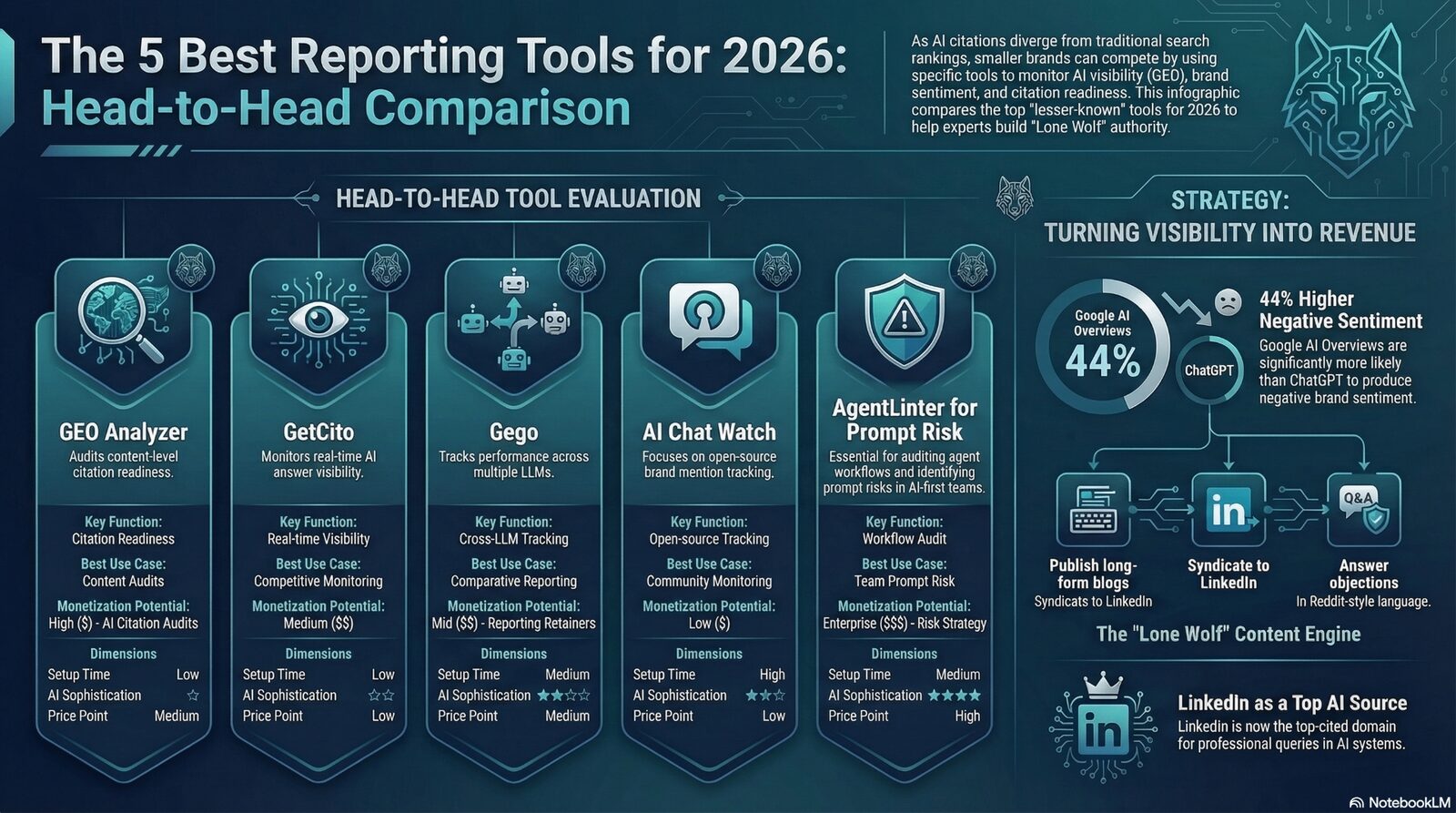
For instance, according to BrightEdge data, Google AI Overviews are 44% more likely than ChatGPT to produce negative sentiment around specific brands. If you aren't tracking how your brand is being described across Google AI Mode, ChatGPT, and others, you're flying blind. Gego lets you see these gaps in real-time so you can adjust your technical signals and "shape" the narrative before a negative LLM bias hurts your conversion rates.
Key Features of Gego
- ●Scheduled cross-LLM brand tracking across ChatGPT, Gemini, Perplexity, and Copilot
- ●Sentiment analysis comparing how each AI describes your brand
- ●Real-time alerts when negative LLM bias is detected
- ●Narrative shaping recommendations based on platform-specific patterns
The Lone Wolf Edge: Gego acts as your 24/7 global monitoring team, allowing a single consultant to manage the digital reputation of multiple brands across the entire LLM landscape simultaneously.
Tool #3: AI Chat Watch — Mastering Reputation Management for the Answer Engine Era
Reputation management has evolved far beyond reviews and PR. AI Chat Watch is an open-source tool designed to track brand mentions within AI-generated conversations. In the GEO era, your reputation is a direct revenue variable. If an AI describes you poorly or cites stale, outdated information, the customer is gone before they ever click your link.
This tool is essential for "source cleanup" and "stale-content correction." It identifies exactly where AI models are pulling incorrect or unflattering "facts" about your brand, allowing you to go to the source—whether it's an old press release or a forgotten wiki—and fix the record.
Key Features of AI Chat Watch
- ●Open-source brand mention tracking inside AI conversations
- ●Source identification for stale or incorrect AI-cited facts
- ●Stale-content correction workflow with prioritized action items
- ●Historical sentiment trend tracking across AI platforms
The Lone Wolf Edge: This tool effectively replaces an entire PR department. It gives you the power to monitor, shape, and correct brand sentiment in real-time, ensuring the AI always has your best "technical side."
Tool #4: GetCito — Real-Time Monitoring of Your Authority on the Modern Source Layer
GetCito provides real-time visibility into how and when your brand surfaces inside AI-generated answers. This is where the strategy gets really high-growth. We know from Profound research that LinkedIn has surged to become the #1 cited domain for professional queries across major AI platforms. Furthermore, Semrush data shows LinkedIn appearing in 11% of AI responses on average.
GetCito helps you track this "source layer" visibility. If you see your LinkedIn articles being cited more frequently than your blog posts, you know exactly where to double down on your distribution.
Key Features of GetCito
- ●Real-time tracking of brand citations inside AI-generated answers
- ●Source layer analysis showing which platforms drive the most AI mentions
- ●Competitive citation benchmarking against rival brands
- ●Channel-level ROI data to prioritize your distribution strategy
> "The fastest way to improve AI visibility for a B2B brand? The fastest way is to combine a strong website with public expert content on highly cited platforms like LinkedIn."
The Lone Wolf Edge: By using GetCito to identify which high-authority platforms (like LinkedIn or Substack) are moving the needle, you can stop wasting time on low-impact channels and focus your energy where the AI is actually looking.
Chart: Head-to-Head Tool Comparison for AI Visibility in 2026
| Tool | Primary Function | Best For | Lone Wolf Value |
|---|---|---|---|
| GEO Analyzer | Content citation audits | Optimizing pages for LLM extraction | Replaces a full SEO audit team |
| Gego | Cross-LLM brand tracking | Monitoring sentiment across AI platforms | 24/7 reputation monitoring for multiple brands |
| AI Chat Watch | AI conversation monitoring | Fixing stale or negative AI-cited facts | Replaces an entire PR department |
| GetCito | Source layer visibility | Tracking which platforms drive AI citations | Pinpoints highest-ROI distribution channels |
| AgentLinter | Agentic workflow auditing | Securing multi-channel content engines | Runs a 20-person agency operation solo |
Tool #5: AgentLinter — Securing Your High-Growth Agentic Content Engine
As we move toward Agentic Engineering, the complexity of our workflows increases. AgentLinter is used for auditing agentic workflows and prompt risk. For the modern consultant, this is a massive service opportunity: helping AI-first teams minimize risk while maximizing the "machine-readability" of their entire operation.
AgentLinter ensures that your "retrievable proof" remains consistent across your entire distribution machine. I recommend a specific content flow to maximize this:
Key Features of AgentLinter
- ●Audits agentic workflows for prompt injection and data leakage risks
- ●Validates consistency of brand messaging across automated pipelines
- ●Ensures machine-readability of multi-channel content distribution
- ●Identifies broken retrieval paths in RAG-powered systems
The Recommended Content Flow
- ●Publish a long-form blog on your hub
- ●Repurpose key sections into LinkedIn posts
- ●Convert the deep analysis into a Substack issue
- ●Answer potential objections in Reddit-style language
- ●Create structured FAQ blocks for snippet capture
The Lone Wolf Edge: AgentLinter ensures this multi-channel flow stays tight and risk-free, allowing you to run a massive distribution engine that looks like it was built by a 20-person agency, all while maintaining your "lone wolf" efficiency.
Conclusion: Building Your Distribution Machine
Owning the AI search era doesn't require a giant team or a bloated agency budget. It requires a system built on distribution and "retrievable proof." In 2026, distribution is the new technical edge. If your expertise is trapped in a silo, it doesn't exist to the machines that now guard the gates of discovery.
The question for the modern specialist is simple: Are you still building an old-school, isolated silo, or are you building a modern distribution machine that AI systems find easy to cite and impossible to ignore? In an era where AI citations are the new currency, is your content built to be read by humans, or trusted by machines?