The era of "set it and forget it" automation is over. Autonomous AI workflows are quietly letting small businesses operate like 10-person teams — without hiring a single extra person.
Let's be real: most SMB owners are drowning in tasks that should never require a human touch. Answering the same customer emails. Manually pulling Google Analytics data every Monday. Posting social content at 6am so it hits the algorithm just right. Chasing down leads that went cold because nobody followed up fast enough.
This isn't a time management problem. It's an infrastructure problem — and agentic AI engineering is the fix.
As the founder of The Techie Bestie and a solo expert who personally handles everything from SEO/CRO to full-stack development and AI workflow engineering, I've watched small businesses transform their operations not by hiring more staff, but by deploying smarter systems. This post breaks down exactly what that looks like, why it matters now, and how you can get started.
What Is Agentic AI — and Why Should SMBs Care?
Most business owners have heard of generative AI — ChatGPT, Midjourney, content generators. These tools are reactive: you prompt them, they respond. Useful, but limited.
Agentic AI is different. Rather than waiting for your next command, an agentic system perceives inputs, reasons through options, takes action, and learns from the outcome — all without requiring step-by-step instructions from you. It's the difference between hiring someone who needs a new task description every five minutes and someone who owns a process end-to-end.
Agentic AI goes beyond analysis to automate parts of complex, high-value workflows — rethinking workflows entirely rather than just cutting a few steps.
According to McKinsey's 2026 workplace AI report, the AI opportunity represents $4.4 trillion in added productivity growth potential from corporate use cases — and the window for early adopters is wide open right now.
For SMBs, this matters because the technology gap between enterprise and small business has essentially collapsed. Platforms that once required six-figure implementation budgets now deploy via visual interfaces in hours. AI agents help small businesses punch above their weight and compete with large companies that have far more resources.
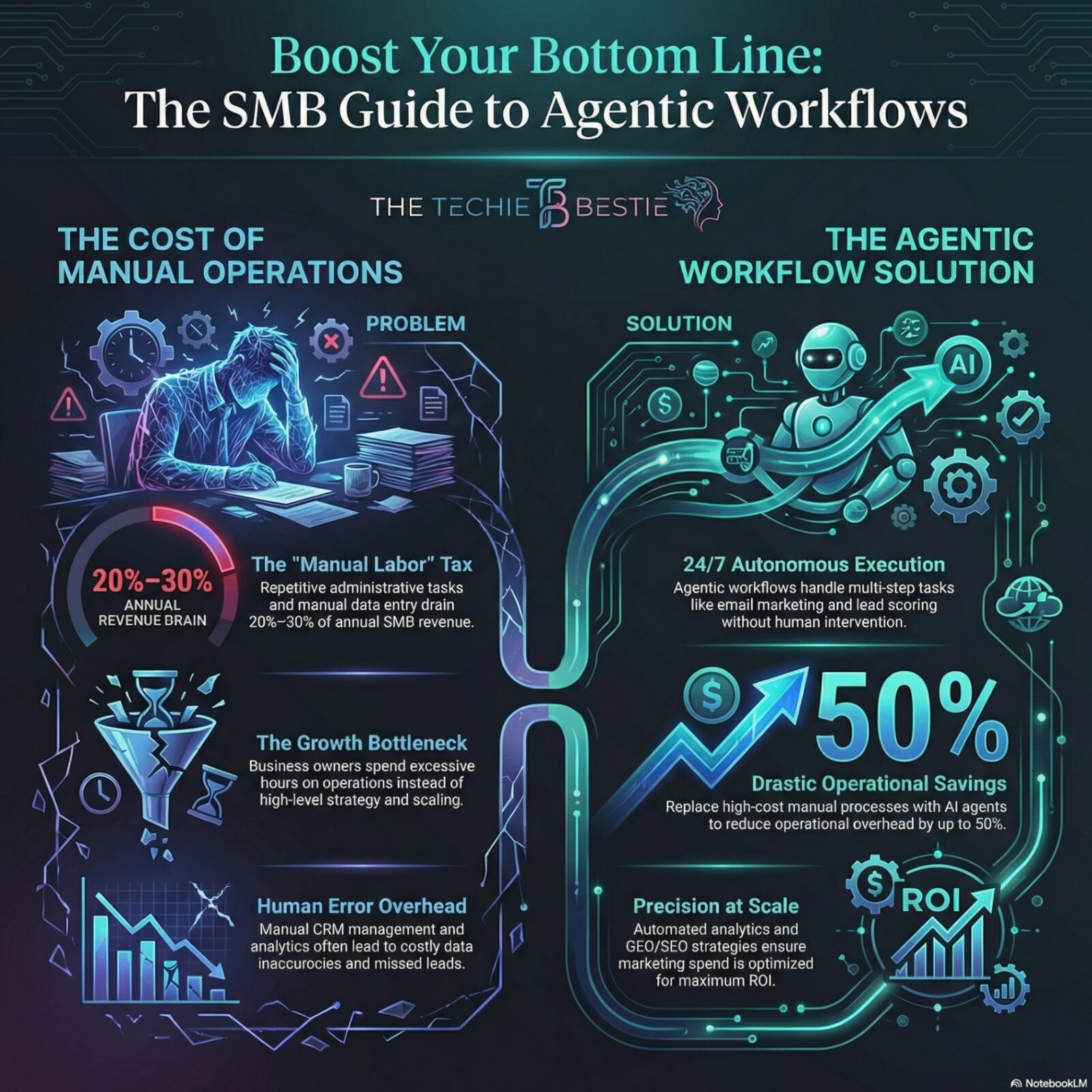
The Real Cost of NOT Using Agentic Workflows
Before I show you the solution, let's talk about what manual processes are actually costing you. Not in vague "wasted time" terms — in actual operational bleeding.
A Salesforce SMB Trends study of 3,350 business leaders found that growing businesses are doubling down on AI investment while stagnant businesses focus primarily on customer acquisition. The gap is widening, and it's not because some businesses got lucky — it's because autonomous systems create compounding efficiency gains that manual operations simply cannot replicate.
Content & SEO Running on Human Hours — Publishing schedules that depend on you. Analytics reports nobody pulls consistently. Keywords that go unmonitored for months. Every day without an agentic content cycle is a day your competitors are gaining ground.
CRM That Requires Manual Baby-Sitting — Leads fall through the cracks. Follow-up emails get sent three days late (or not at all). Pipeline stages get stuck because moving them requires human action. AI agents handle multi-step CRM workflows independently — including lead nurturing sequences that respond to behavior in real time.
Overhead Sized for a Business Twice Your Size — Large internal teams exist to manage complexity. Agentic AI replaces the manual logistics layer, meaning you can operate at greater scale without the corresponding headcount — reducing overhead costs while increasing output quality.
The 3-Step Transition to Agentic Workflows
The transition isn't a switch you flip — it's a layered build. Here's how The Techie Bestie approaches it with SMB clients, moving from foundational visibility all the way to fully autonomous content and lead operations.
Integrated SEO & Content Strategy (AEO-First)
We don't start with keywords — we start with answer architecture. Moving beyond basic keyword targeting to SEO-enriched frameworks and Answer Engine Optimization (AEO) ensures your content is visible not just in traditional search, but in AI-generated answer surfaces like ChatGPT, Perplexity, and Google's AI Overviews. This is where most competitors are leaving ranking real estate on the table.
Implementing Agentic Engineering Across Core Workflows
This is where AI stops being a "tool you use" and becomes infrastructure that runs processes. Lead nurturing sequences that respond to prospect behavior. CRM pipelines that self-manage stage progression. Google Analytics anomaly alerts that trigger action without requiring your attention. Each workflow is designed so AI agents manage complex, multi-step tasks independently — with appropriate human oversight built in.
Autonomous Content Cycles
Publishing schedules that run on high-quality, research-backed autonomous workflows. Video strategy, social content, and email marketing that operates on an intelligent cadence — consistent, on-brand, and SEO-optimized — without requiring your daily involvement. This is the stage where SMBs begin to reclaim 10–15 hours per week of founder time.
According to pdfFiller's 2026 SMB Growth Report, the small businesses that will thrive aren't necessarily those with the most sophisticated AI — they're the ones that thoughtfully integrate AI into core workflows and measure real outcomes. That's the philosophy behind every engagement at The Techie Bestie.
The Lone Wolf Advantage: Why a Solo Expert Outperforms an Agency
Here's a question most SMB owners don't think to ask when evaluating AI consultants: Who is actually doing the work?
At most agencies, you pay senior-level rates and get junior-level execution, passed through layers of account management, project management, and offshore fulfillment. The person who pitched you your strategy isn't the one building it.
The Techie Bestie model is different by design. Operating as a high-level solo expert means you get someone who personally handles your SEO strategy, your CRM engineering, your AI workflow architecture, and your content analytics — not a rotating cast of account coordinators quoting briefs at each other.
This matters especially for agentic AI work, because the quality of the system is entirely dependent on the quality of the thinking behind it. An autonomous workflow built by someone who understands both the technical architecture and the business strategy will outperform one built by a team that's never had to own the outcome.
The best agentic systems aren't built by the largest teams — they're built by the people who understand the problem deeply enough to design around it.
What This Looks Like in Practice
Here's a real-world example of how an agentic workflow stack transforms an SMB's operations: a service-based business with a two-person team was spending roughly 18 hours per week on content publishing, lead follow-up, and reporting. After implementing an agentic engineering layer — autonomous content scheduling, CRM behavior-triggered sequences, and a live analytics dashboard — that time dropped to under 4 hours. Same output quality. More consistent execution. Zero additional headcount.
That's not automation in the traditional sense. That's infrastructure that thinks.