OK so I need to tell you about something that completely changed how I think about content structure. You know how we've all been taught to "build up" to the good stuff in a blog post? Tease the reader, set the scene, drop the mic at the end? Yeah, that's literally the opposite of what works in AI search. And now we have the receipts to prove it.
New research from Kevin Indig's Growth Memo analyzed over 1.2 million ChatGPT responses and tracked exactly where on a page AI pulls its citations from. The results are wild, specific, and honestly? A little humbling for anyone (including me) who's ever buried the lede.
Here's the thing: if your best insight lives in paragraph seven, you are invisible to AI search. And this applies across every vertical, from fintech to SaaS to construction. Let me break it down.
The "Ski Ramp" Pattern That Changes Everything
Kevin Indig, a growth advisor who's worked with Shopify, Reddit, Dropbox, and Ramp, had his team match AI-generated answers to specific source sentences using machine learning. They tracked the location of those sentences to the exact position on the page.
The results held across every vertical studied:
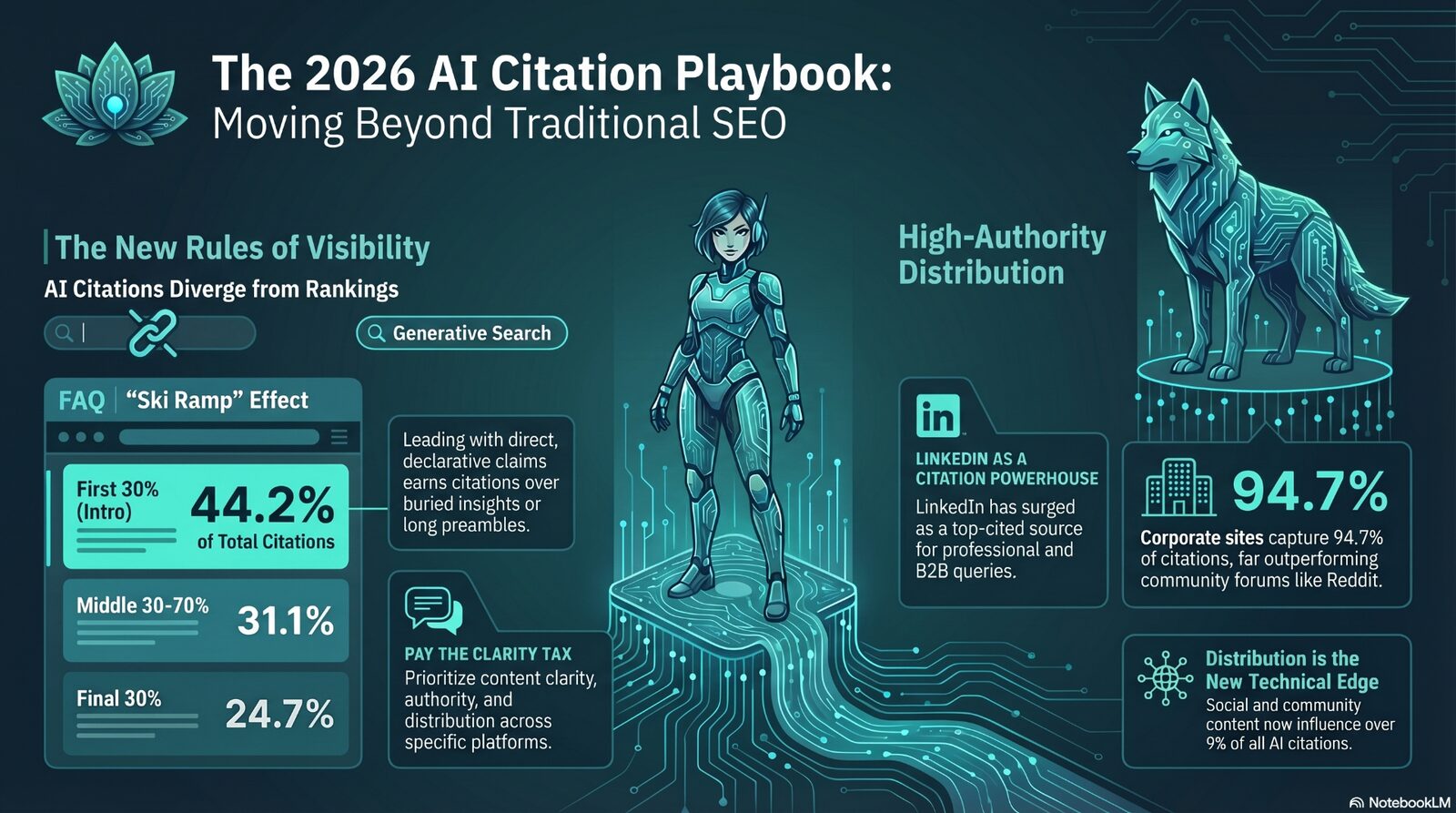
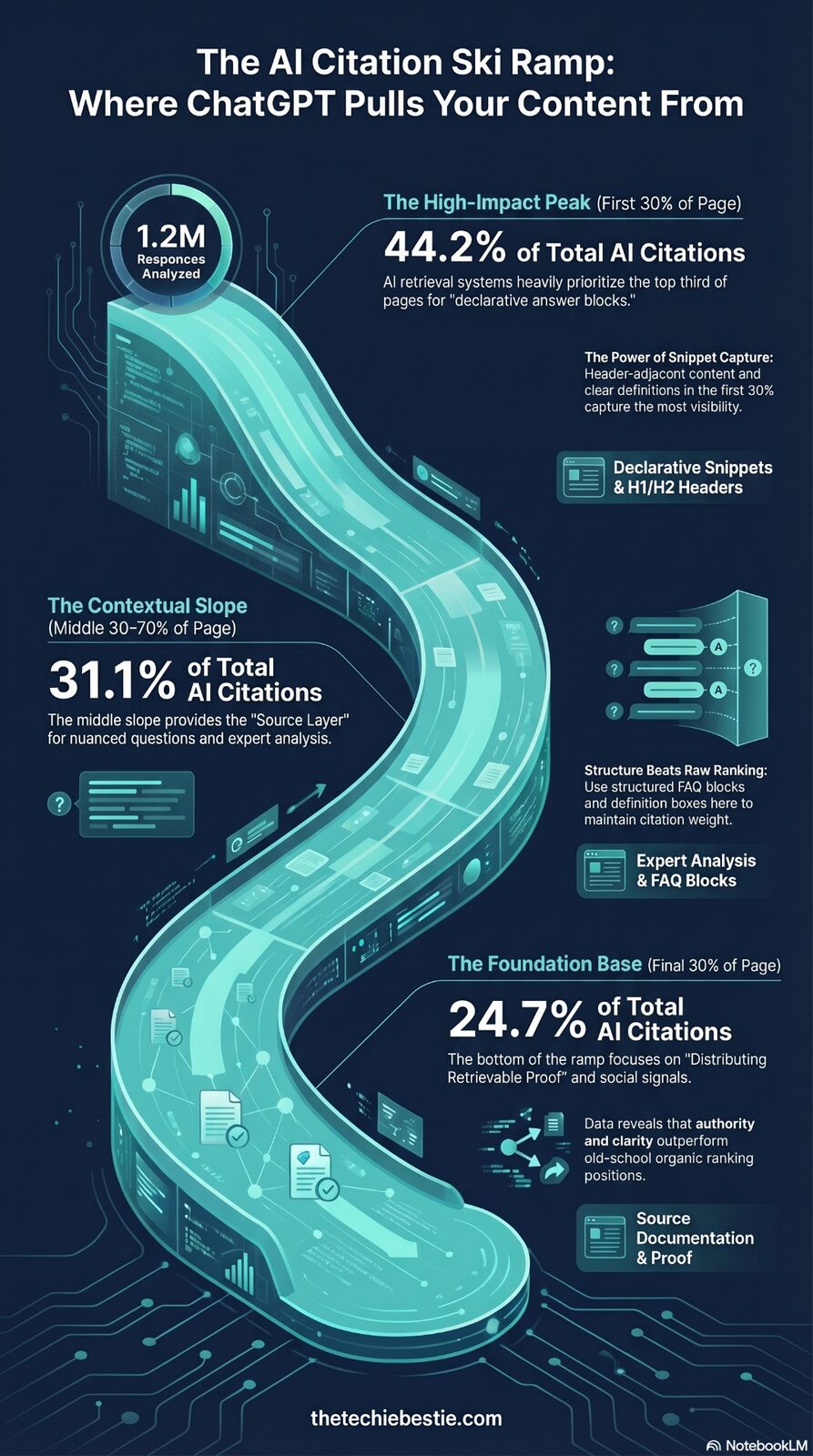
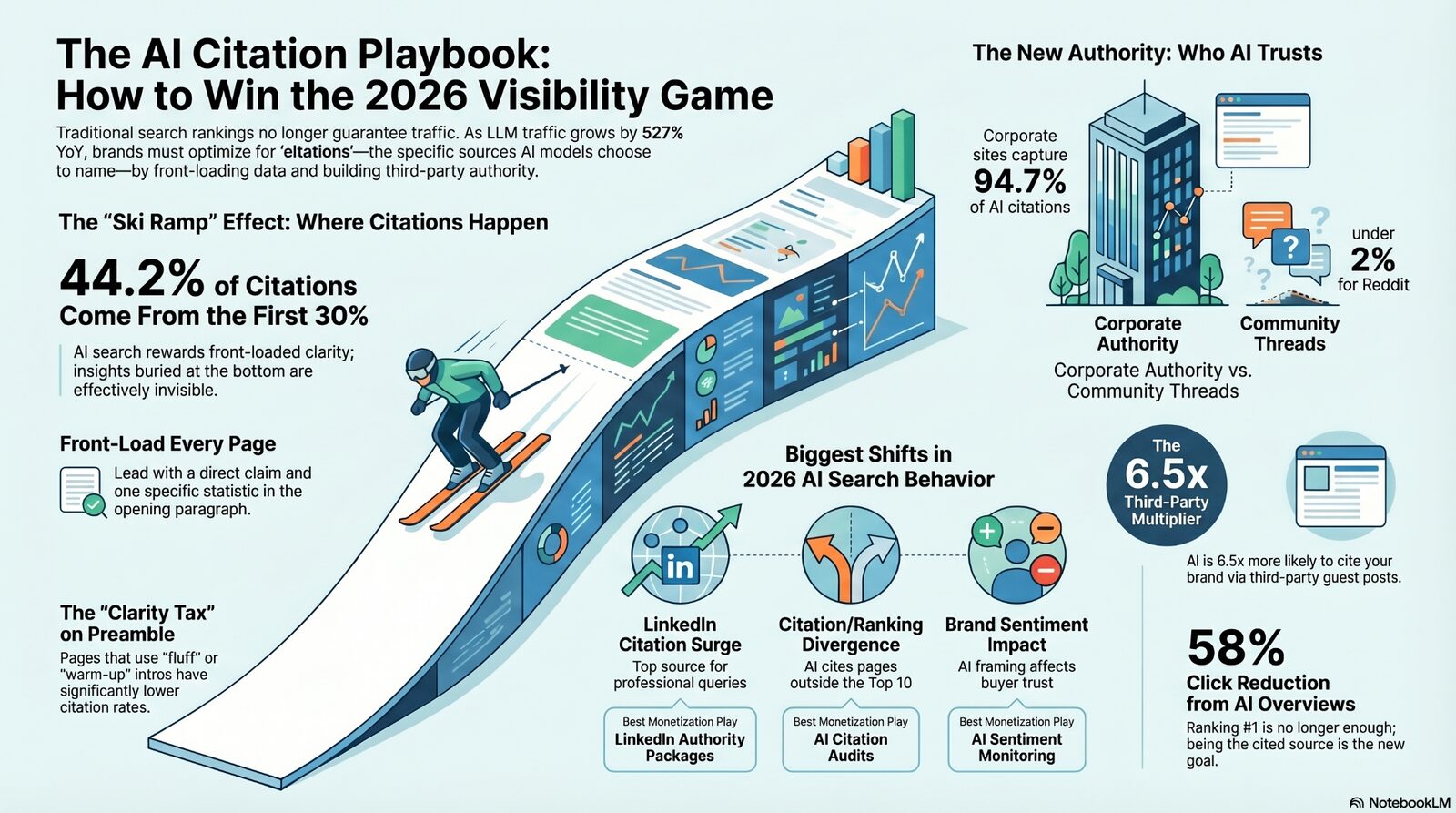
- ●44.2% of all LLM citations come from the first 30% of a page
- ●31.1% come from the middle section (30-70% of the page)
- ●24.7% come from the final third
- ●Pages that open with hedging language ("in this article, we'll explore...") are already behind
Indig calls this the "clarity tax." If your content buries the answer, AI moves on. Traditional blog writing rewards the payoff at the end. AI citation rewards the payoff at the top.
There's also a second signal that holds universally across all seven verticals studied: pages that include a publication date and at least one specific number in the opening paragraph earn higher citation rates. Definite, declarative sentences outperform questions. Numbers and dates aren't optional decoration, they're visibility signals.
What this means for your content structure:
- ●Lead every blog post with a direct claim, not a setup
- ●State your main finding or conclusion in the first paragraph, not the last
- ●Include at least one stat with a source citation in the opening section
- ●Remove all preamble ("Today we're going to talk about...")
- ●Use 120-180 words between headings for optimal scan density
| Content Position | % of Total Citations | What This Means |
|---|---|---|
| First 30% of page (intro) | 🟢 44.2% | Your intro IS the content AI reads and decides whether to cite |
| Middle 30-70% of page | 🟡 31.1% | Supporting detail matters but carries less citation weight |
| Final 30% of page | 🔴 24.7% | Bottom-loaded insights get cited least by AI |
*Source: Kevin Indig / Growth Memo, February 2026. Analysis of 1.2M ChatGPT responses and 18,012 verified citations.*
Corporate Authority Wins the AI Citation Game
The same research produced a finding that upends a common assumption. Many SEOs assumed that AI models would favor community-driven content like Reddit threads, forum posts, and user-generated platforms. The data says otherwise.
Out of nearly 100,000 citations analyzed in Indig's citation-source study, corporate sites captured 94.7% of them. In regulated verticals like finance and healthcare, user-generated content sits at under 2%. AI heavily favors structured, authoritative corporate content.
This matters for B2B brands that have been timid about publishing opinionated, data-backed content. The "let the forums do the talking" strategy does not translate to AI visibility. Structured pages, expert attribution, and factual depth outperform community threads in almost every non-technical vertical.
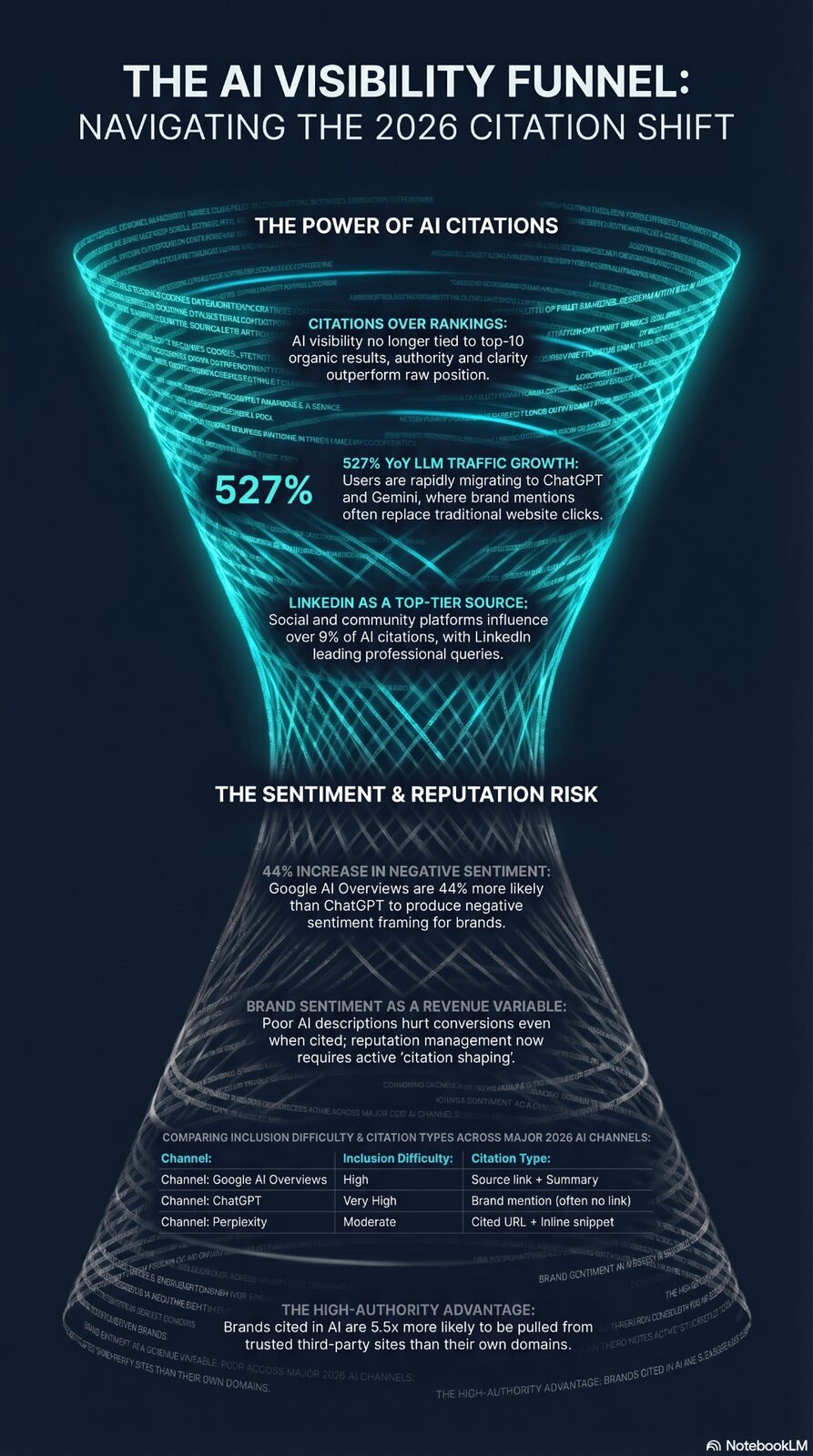
One additional data point reinforces this: a SparkToro study run across 2,961 prompt tests found that there is less than a 1-in-100 chance that ChatGPT produces the same brand recommendation list twice. AI "rank" as a concept doesn't exist. What does exist is whether your brand is in the consideration set. That consideration set is driven by authoritative, third-party coverage in publications AI trusts, not by chasing citation positions.
What This Means for Your Industry
Fintech and AP Automation
Your buyers are running searches like "best AP automation software" or "how does invoice processing work" in ChatGPT and Perplexity. If your content buries the answer in the third section, you are invisible. Lead with the claim. Back it with a number. AP automation content that restructures intros around direct answers will earn more AI citations than content that builds slowly toward a conclusion.
B2B SaaS
SaaS companies live and die on organic. According to AirOps research published in April 2026:
- ●Comparison pages with three or more data tables earn 25.7% more ChatGPT citations
- ●Structured pages with short sentences (under 10 words average) earn 18.8% more
- ●If your SaaS blog posts read like whitepapers, they are underperforming in AI search right now
Construction and Restaurants
Local queries are changing fast. Aleyda Solis flagged in SEOFOMO on April 5, 2026 that ChatGPT now enables location sharing for more localized "near me" results. Local service businesses need structured, direct-answer content with specific location signals in the first paragraph. "We serve Austin, TX commercial contractors" in paragraph one beats a generic intro every time.
Cybersecurity
Security content is one of the highest-citation verticals in AI. Buyers trust authoritative sources. Front-loaded, data-backed content from recognized expert voices earns citations. UGC doesn't. If your security blog sounds like a Wikipedia article, that's actually closer to what AI wants than a casual conversational post.
FAQ
What percentage of content does ChatGPT cite from the top of a page?
Research from Kevin Indig's Growth Memo shows 44.2% of all ChatGPT citations are pulled from the first 30% of a page's content. This pattern held across 1.2 million responses analyzed.
Does corporate content outperform Reddit in AI citations?
Yes. Across nearly 100,000 citations analyzed, corporate sites captured 94.7% of AI citations. User-generated content like Reddit threads performed below 2% in regulated verticals like finance and healthcare.
How should I structure blog posts for AI citation?
Lead with a direct declarative statement. Include a publication date and at least one specific statistic in the opening section. Use 120-180 words between headings. Avoid any preamble or setup language in the first paragraph.
Does Google still matter for AI visibility?
Yes. Research from AirOps found that 55.8% of ChatGPT-cited pages ranked in Google's top 20. Pages ranking at position 1 in Google had a 3.5x higher ChatGPT citation rate than pages outside the top 20. Strong SEO is still the foundation of AI visibility.
Are ads appearing in AI search results?
Google now shows ads in 25.56% of AI Overview results as of late 2025, up from 5.17% in March. That's a 394% increase. Sponsored placements inside AI Mode conversations are also being tested.
What content types get cited most in ChatGPT?
According to Ahrefs research on cited page types, "best X" listicles account for 43.8% of all page types used as AI research sources. Comparison pages, data-driven guides, and structured how-to content follow closely behind.
Start Building for AI Visibility Now
The window to establish your brand in AI consideration sets is now. Once the ad auctions open inside AI Mode and ChatGPT, the cost to appear will compound fast. Right now, content quality and structure still determine who gets cited.
If your site is publishing slow-building blog posts with buried insights and generic intros, you are leaving AI visibility on the table. The fix isn't a platform change, it's a structural one.
The Techie Bestie content strategy service is built for exactly this moment. We rebuild content architectures for B2B and local brands that need to show up in both traditional and AI search. Our SEO services are designed for brands in fintech, SaaS, construction, and beyond who are ready to stop guessing and start ranking where it counts.