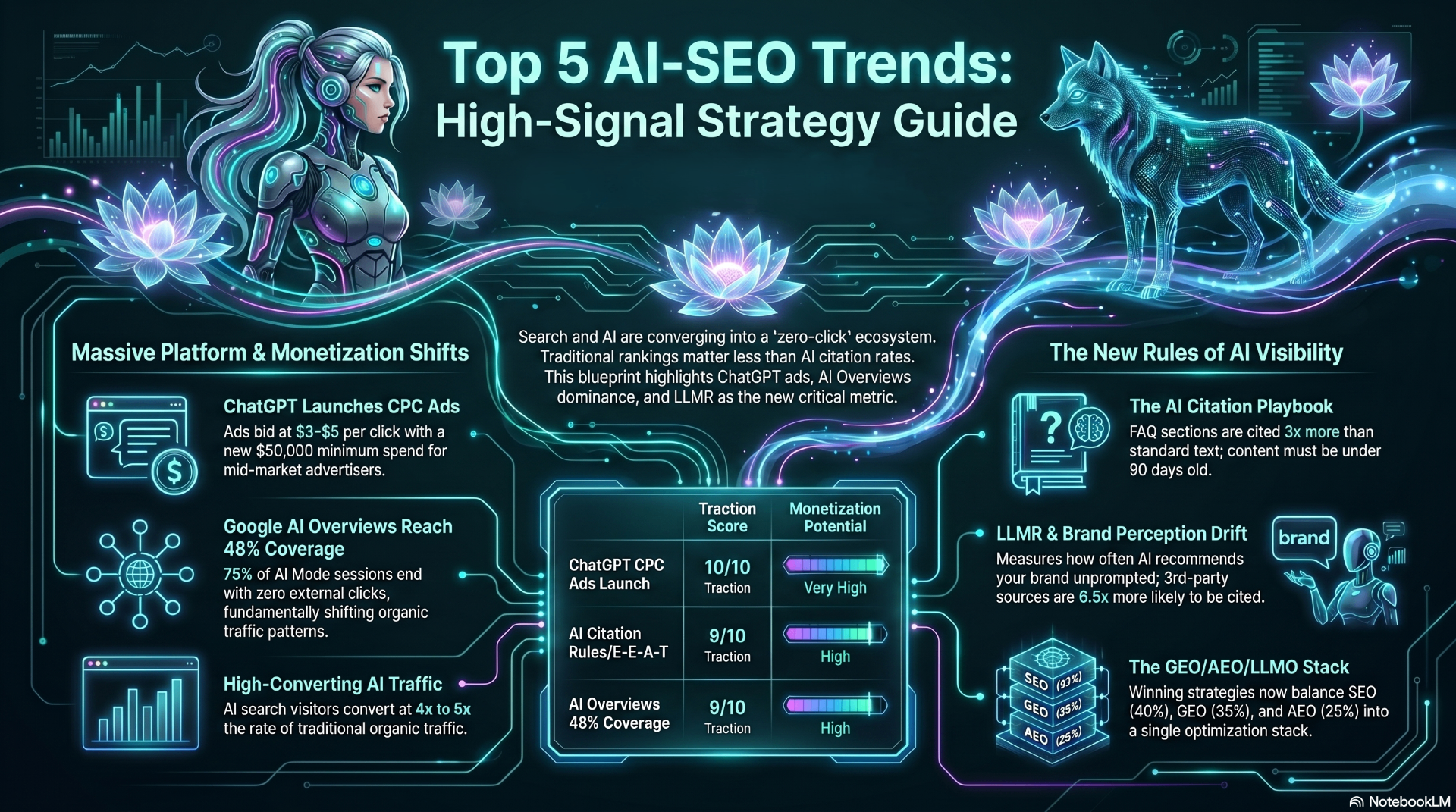
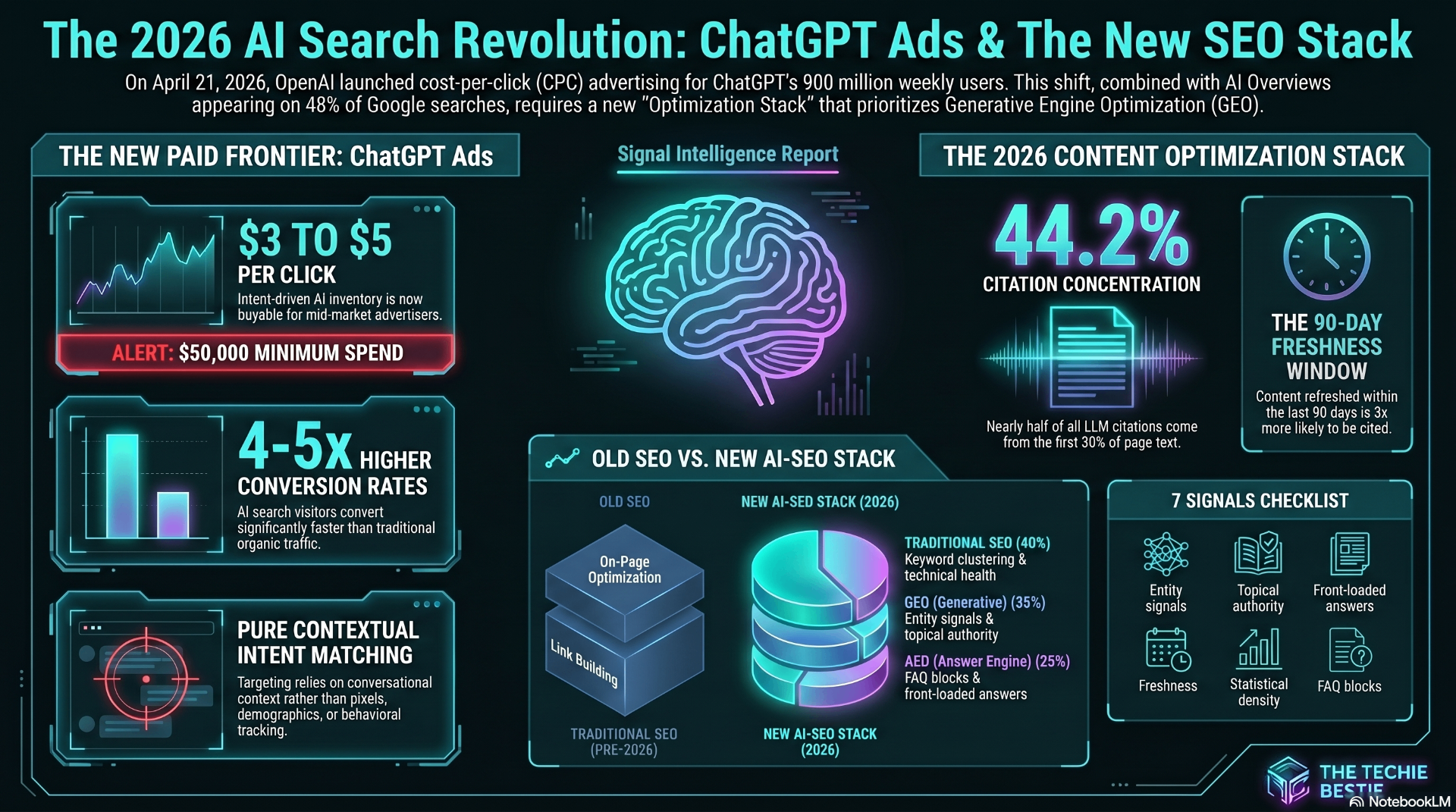
Bestie, this is the moment. ChatGPT launched cost-per-click advertising on April 21, 2026, and the implications for SEO professionals are significant. For the first time, intent-driven AI search inventory is buyable at $3 to $5 per click.
If you have been waiting for AI search to feel real, this is it. OpenAI built a platform with 900 million weekly users, proved those users will click on relevant sponsored results, and opened the floodgates to mid-market advertisers at a $50,000 minimum spend. The brands that move now will lock in early audience relationships at costs that will look laughably cheap in 18 months. We have seen this movie before, in 2000 with Google display ads. History is repeating.
If you want the macro context for why this matters, pair this post with The Biggest SEO, LLM, and AI Shifts in the Past 30 Days and GEO Optimization Strategy 2026.
What ChatGPT Ads Actually Are and How They Work
ChatGPT ads appear at the bottom of AI-generated answers for Free and Go tier users. They are clearly labeled as sponsored content and matched to the conversational context of each query. Ads do not influence ChatGPT answers. OpenAI has been explicit about this: the answer layer and the ad layer are separated by design.
As of today, advertisers access a self-serve ad manager where they can:
- ●Set maximum bids per click
- ●Choose geographic targeting at the country level
- ●Provide context hints that help match ads to relevant queries
- ●Access basic reporting on impressions and clicks
The available targeting is still minimal compared to Google or Meta. There is no pixel, no post-view attribution, and no behavioral or demographic targeting. What you get instead is pure contextual intent matching based on what the user is actively asking about.
That limitation is also the opportunity. Users asking ChatGPT questions are closer to a decision than most display or social audiences. The CPM started at $60 and has already dropped to $15 to $40 as more inventory came online. If you are a B2B brand, a SaaS product, or a service business with a strong content presence, this is early adopter territory.
What This Means for Organic SEO and Content Strategy
The launch of ChatGPT ads accelerates a shift that was already happening. AI Overviews now appear on 48% of Google searches as of April 2026, LLM bots crawl 3.6x more frequently than Googlebot, and over 80% of searches end without a click to any website. The channel where your organic SEO used to dominate is contracting, and the channel where the new traffic lives requires a completely different optimization playbook.
The content scoring model that outperforms in 2026 weights GEO at 35%, SEO at 40%, and AEO at 25%. That is not a replacement for traditional SEO. It is a layer on top of it. The technical foundation still matters. Clean crawlability, proper schema markup, fast Core Web Vitals, and strong E-E-A-T signals are the prerequisite for AI visibility. Without those, generative optimization has nothing to work with.
I unpacked the deeper version of this in GEO vs SEO in 2026 and The End of SEO As We Know It. Read both before you rebuild your content strategy.
Content Optimization Weight for 2026 AI Search
| Optimization Layer | Weight in 2026 Stack | Primary Target | Key Tactic |
|---|---|---|---|
| Traditional SEO | 🟢 40% | Google blue links | Keyword clustering, backlinks, technical health |
| GEO (Generative Engine) | 🟢 35% | ChatGPT, Perplexity, Gemini | Entity signals, topical authority, citation depth |
| AEO (Answer Engine) | 🟡 25% | AI Overviews, featured snippets | FAQ blocks, front-loaded answers, schema |
The 7 Signals That Actually Get You Cited in ChatGPT
A study released April 20, 2026 by Trustpoint Xposure interviewed AI search engineers to identify the exact ranking signals ChatGPT prioritizes. The findings align with what Ahrefs, Semrush, and SE Ranking have published this year. Here is what actually works.
- ●Entity recognition: Your brand, product, and author must appear consistently across multiple high-trust sources. Schema markup accelerates this.
- ●Topical authority: Thin content clusters get ignored. Deep, comprehensive coverage of a topic tells the model you are the definitive source.
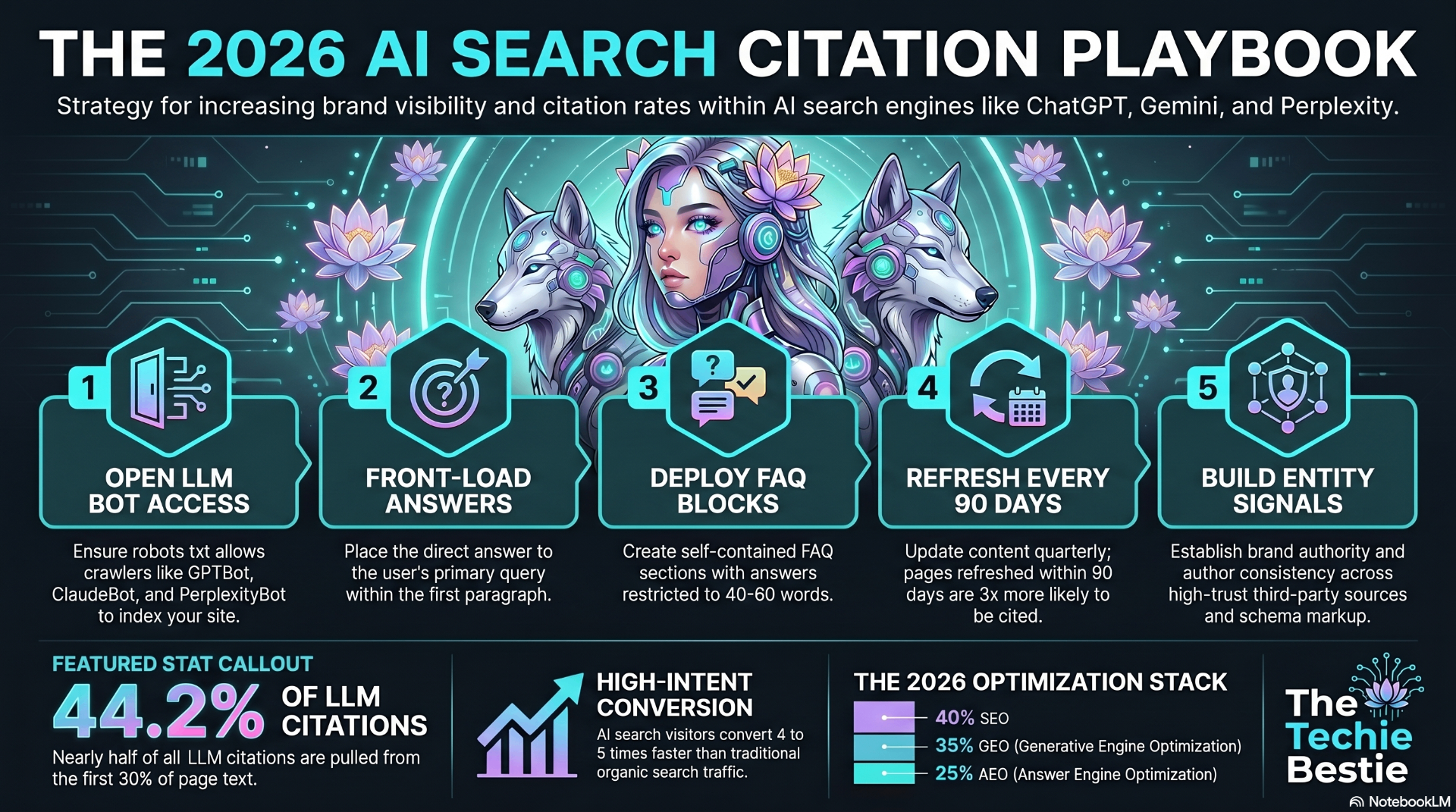
- ●Front-loaded answers: 44.2% of LLM citations come from the first 30% of text. Put your best answer in paragraph one. I broke down the data in Why 44% of AI Citations Come From Your Intro.
- ●FAQ sections: FAQ blocks with 40 to 60 word self-contained answers are cited 3x more than standard paragraph content.
- ●Content freshness: Pages refreshed within 90 days are 3x more likely to be cited. Set a quarterly refresh calendar.
- ●Statistical density: Content with data and statistics earns 28 to 40% higher AI visibility. Cite sources and include charts.
- ●Referring domain authority: Sites with 32K+ referring domains are 3.5x more likely to appear in ChatGPT answers than low-DA sites.
ChatGPT Ads vs Google Ads at a Glance
| Capability | Google Ads | ChatGPT Ads (April 2026) |
|---|---|---|
| Targeting Model | 🟢 Demographic, behavioral, contextual | 🟡 Contextual intent only |
| CPC Range | 🟡 $1 to $50+ (varies by vertical) | 🟢 $3 to $5 |
| Minimum Spend | 🟢 None | 🔴 $50,000 |
| Pixel and Attribution | 🟢 Full funnel tracking | 🔴 Not yet available |
| Inventory Maturity | 🟢 Saturated | 🟢 Early adopter window |
| Audience Intent | 🟡 Mixed | 🟢 High, decision-stage |
What SEOs Should Do This Week
The most actionable move for any SEO professional right now is auditing whether your AI bot access is open. There are six LLM crawlers actively indexing the web: GPTBot, OAI-SearchBot, ClaudeBot, PerplexityBot, Google-Extended, and Applebot-Extended. If your robots.txt blocks any of them, you are invisible to those systems. Check it today.
Second, run a content freshness audit. Any page older than 90 days that targets a high-value keyword should be updated with:
- ●Current data and 2026 statistics
- ●An expanded FAQ block with self-contained 40 to 60 word answers
- ●A statistics-dense section with cited sources
- ●Updated entity signals and schema
These three changes alone can significantly improve AI citation rates within a 30-day window.
Third, monitor your AI brand presence. Tools like Profound and Peec AI give you a baseline score for how often your brand appears in ChatGPT, Gemini, and Perplexity answers. You cannot optimize what you cannot measure. I covered the full stack in The New Visibility Playbook: 5 Essential Tools to Own the AI Search Era.
Where This Fits in the Bigger Shift
ChatGPT ads are not a side experiment. They are the start of a paid layer on top of an answer engine that is already eating the click. The brands that win this cycle will be the ones running paid intent capture and organic citation strategy in parallel, not in silos. If you want the operator view on building those systems, Why Agentic Engineering Is the SMB Game-Changer and The Lone Wolf Advantage both pair really well with this one.
FAQ: ChatGPT Ads and AI SEO in 2026
What are ChatGPT ads and who sees them?
ChatGPT ads are sponsored placements that appear below AI-generated answers. They are visible to Free and Go tier users only. Plus, Pro, Business, Enterprise, and Education users do not see ads. Ads are matched to the conversational context of each query and clearly labeled as sponsored content.
How is ChatGPT advertising different from Google Ads?
ChatGPT advertising is contextual and intent-based, matching ads to what a user is actively asking about in a conversation. Unlike Google Ads, there is currently no pixel tracking, no demographic targeting, and no post-view attribution. The CPC model ($3 to $5 per click) and minimum spend ($50,000) reflect an early-stage platform still building its measurement infrastructure.
Will ChatGPT ads affect organic SEO rankings?
No. OpenAI has confirmed that ads do not influence ChatGPT answers. The answer generation layer and the ad layer are structurally separated. Your organic citation potential in ChatGPT is driven by content quality, entity signals, topical authority, and domain credibility, not by ad spend.
What is GEO and why does it matter in 2026?
Generative Engine Optimization (GEO) is the practice of structuring your content and brand presence so that AI platforms like ChatGPT, Gemini, and Perplexity cite you when users ask relevant questions. It matters because 31.3% of the US population is expected to use generative AI search in 2026, and AI-referred visitors convert at 4 to 5x the rate of traditional organic visitors.
How do I check if LLM bots can crawl my site?
Open your robots.txt file and verify that none of these user agents are blocked: GPTBot, OAI-SearchBot, ClaudeBot, PerplexityBot, Google-Extended, Applebot-Extended. If any are listed under Disallow rules, you are invisible to those AI systems. Remove the restrictions and resubmit your sitemap.
What is the fastest way to improve AI citation rates?
Three moves produce the fastest results: refresh any page older than 90 days with new data and statistics, add a FAQ block with 40 to 60 word self-contained answers to every key content page, and ensure your opening paragraph contains a direct answer to the primary question the page targets. These tactics align with how LLMs extract and cite content.
Final Thoughts
ChatGPT ads are the early adopter window. The CPCs will go up. The targeting will get smarter. The minimum spend will eventually come down. But the brands that lock in audience relationships and citation authority right now will be the ones the model recommends, and the ones the ads serve to, when the rest of the market wakes up in 2027.
Build for both layers. Win both. Do not pick one.
Ready to See What Full-Spectrum AI Strategy Costs?
If you want a paid plus organic AI visibility plan that actually fits your business (no agency bloat, no surprise retainers), view my pricing or book a strategy call. I will show you exactly where to spend, where to publish, and where to skip.