How to get cited by AI search comes down to page structure, not secret files. A SISTRIX study of 96,418 pages found that a linked table of contents, Article schema, and five or more H2s lifted citations, while llms.txt showed no measurable effect.
Here is the number that stopped me. Only 14% of the pages in the study had a linked table of contents, yet those pages were cited 1.7 times as often by OpenAI ChatGPT, Google AI Mode, and Google AI Overviews. The fix takes about an hour, and most sites spent that hour writing an llms.txt file instead.
{{TOC}}
What the SISTRIX AI Citation Study Found
AI citation worthiness is the set of page features that make an AI search engine more likely to link your page as a source in its answer. SISTRIX set out to measure it on real pages, not on opinions.
The SISTRIX citation worthiness study, published October 22, 2026, compared 48,527 pages cited by ChatGPT, AI Mode, and AI Overviews against uncited pages from the same websites. That came to 96,418 pages across 17,380 domains, each scored on 43 features. The data covers Germany, Austria, and Switzerland in Q2 2026.
Comparing cited and uncited pages from the same sites is the smart part. It strips out domain authority, so what is left is the page itself. Here is what moved the needle:
- ●Linked table of contents: cited 1.7 times as often, and only 14% of pages had one.
- ●Article schema: 1.6 times as often, and 2.0 times in AI Overviews alone.
- ●Five or more H2 headings: 1.6 times as often, and 1.8 times in AI Mode.
- ●FAQPage schema: 1.5 times as often.
- ●Question-style H2s: 1.4 times as often.
- ●Tables with a header row: 1.8 times as often in ChatGPT.
Pages that met many of the study's eleven core optimization criteria were cited 2.1 times as often as barely optimized pages. Readability scores barely mattered at 1.03x, HowTo schema landed at 1.0x, and Product schema came in at 0.8x overall and 0.5x in AI Overviews. Only 5% of pages showed a visible last-updated date.
One caution. These are correlations from German-language markets, not proof that a table of contents causes citations. Still, every winning feature does the same job: it makes a page easy for a machine to split into clean, labeled answers.
Chart: AI Citation Lift by Page Feature
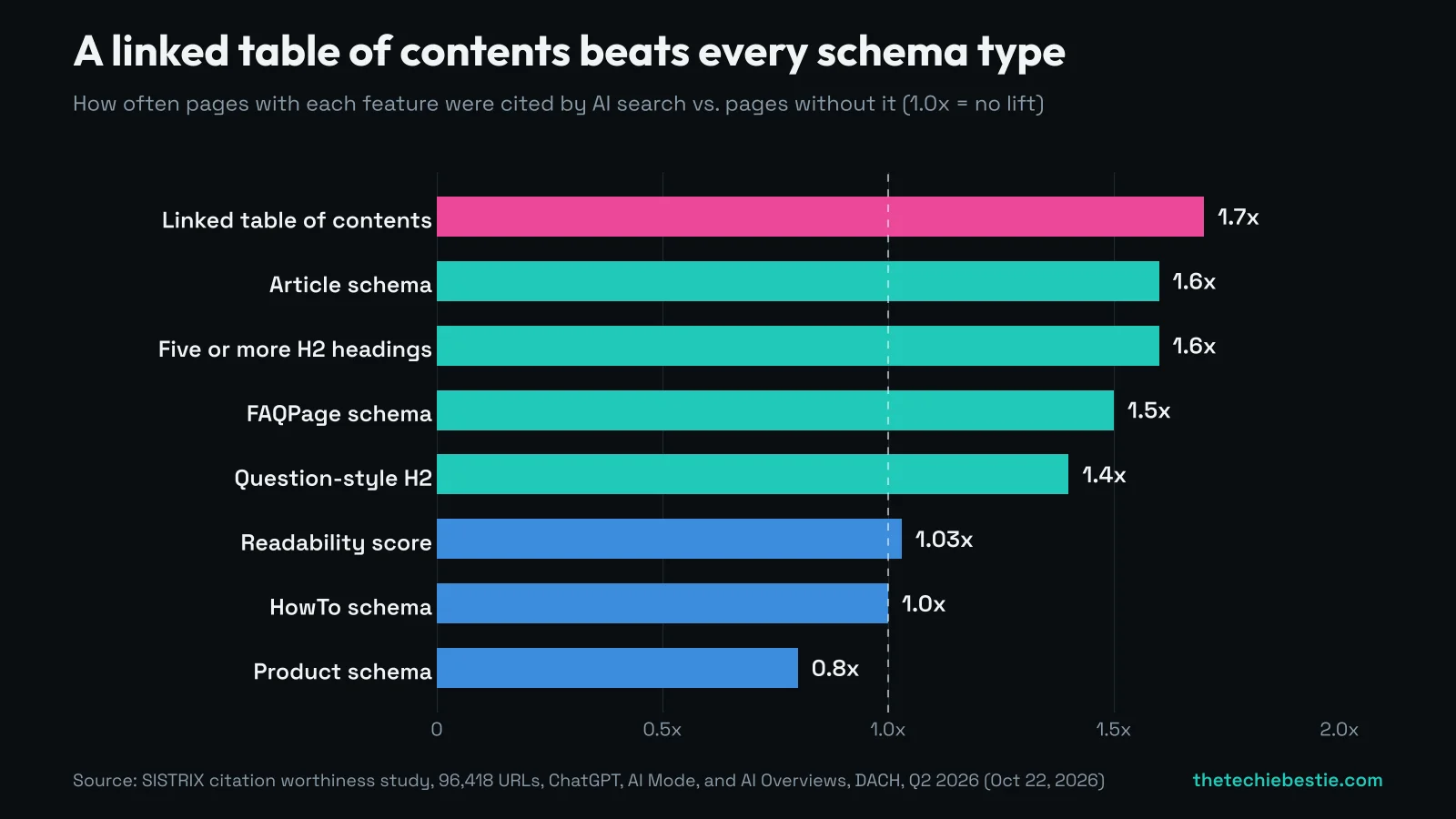
*A linked table of contents was the strongest single page feature for earning AI citations, ahead of every schema type.*
Citation rate of pages with each feature compared with pages without it, ChatGPT, Google AI Mode, and Google AI Overviews, Germany, Austria, and Switzerland, Q2 2026.
Data Table
| Page feature | Citation lift (1.0x = no lift) |
|---|---|
| Linked table of contents | 1.7x |
| Article schema | 1.6x |
| Five or more H2 headings | 1.6x |
| FAQPage schema | 1.5x |
| Question-style H2 | 1.4x |
| Readability score | 1.03x (not significant) |
| HowTo schema | 1.0x |
| Product schema | 0.8x |
Source: SISTRIX, "Citation Worthiness: Which GEO Tactics Hold Up Across 96,418 URLs," October 22, 2026.
A table of contents with jump links did more for AI citations than any schema type tested.
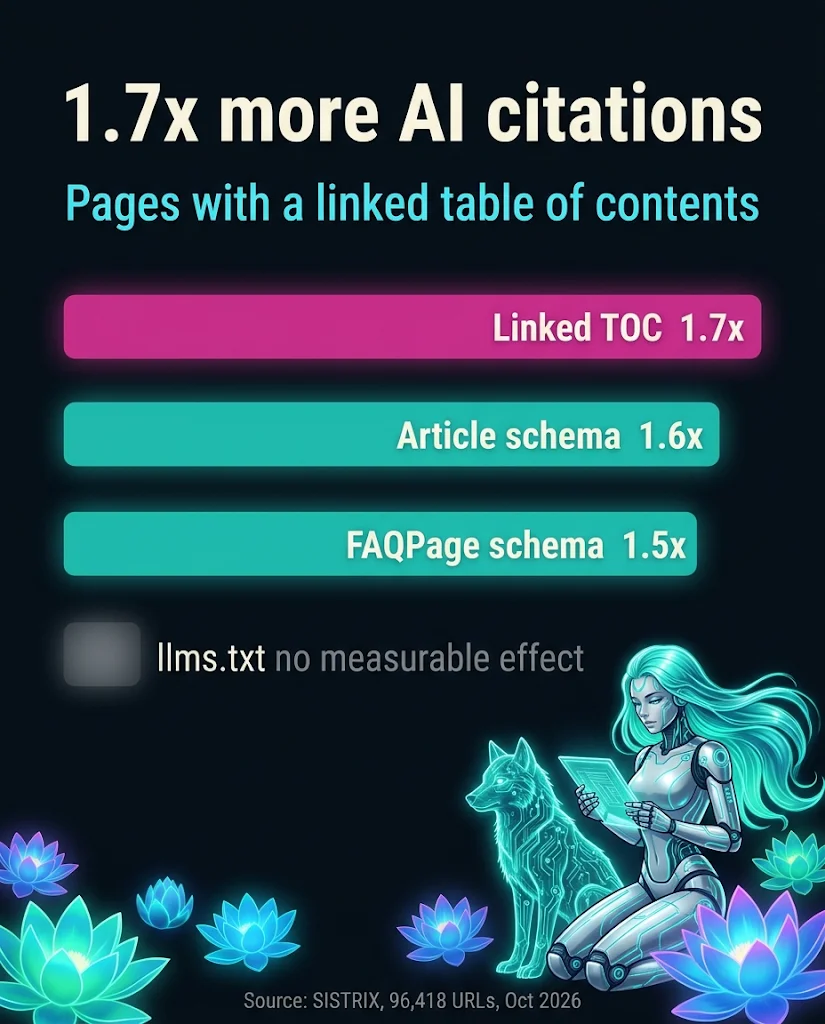
Chart: Which Feature Wins in Each AI Engine
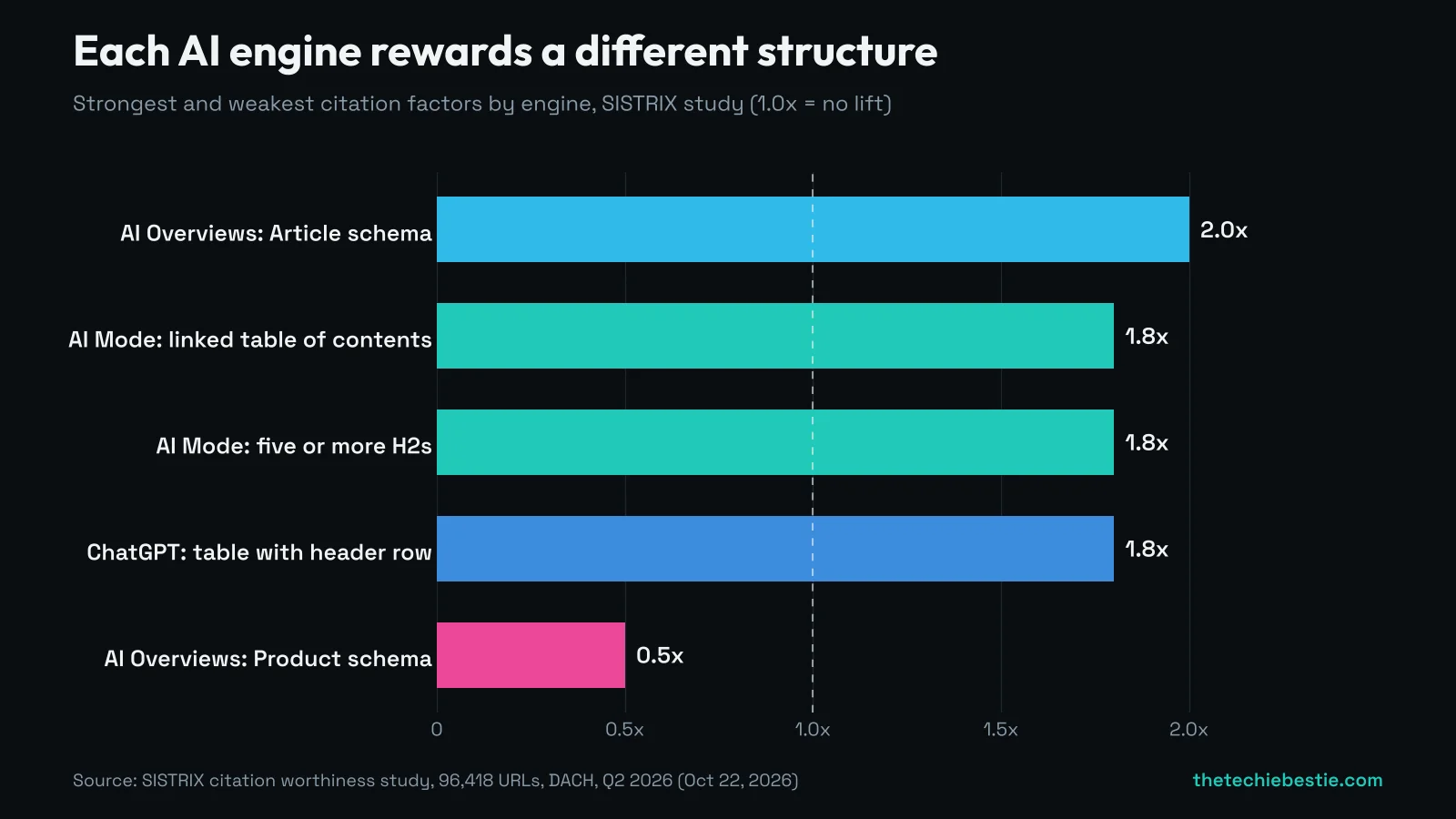
*Each AI engine rewards a different structure, so one page needs all three: a linked table of contents, Article schema, and real tables.*
Strongest and weakest citation factors by engine, SISTRIX study, Germany, Austria, and Switzerland, Q2 2026.
Data Table
| AI engine | Feature | Citation lift |
|---|---|---|
| Google AI Overviews | Article schema | 2.0x |
| Google AI Mode | Linked table of contents | 1.8x |
| Google AI Mode | Five or more H2 headings | 1.8x |
| OpenAI ChatGPT | Table with a header row | 1.8x |
| Google AI Overviews | Product schema | 0.5x |
Source: SISTRIX citation worthiness study, October 22, 2026.
Google's two AI surfaces and ChatGPT each grade structure differently, so cover all three on every key page.
This lines up with what I covered in ChatGPT vs Gemini vs Perplexity vs Google AI Mode vs Copilot. Every engine has its own taste. Structure is the one thing all of them reward.
Why llms.txt AI Citations Did Not Show Up
The llms.txt proposal asks site owners to publish a markdown file that summarizes their site for large language models. It spread fast in 2025 because it felt like robots.txt for AI. The data says it is not doing much for citations yet.
In the SISTRIX sample, 11.7% of cited pages came from domains with an llms.txt file, against 14.0% across all domains. SISTRIX's own conclusion is that "there is no measurable effect on AI citations." Google has also said there are no additional requirements to appear in AI Overviews or AI Mode beyond normal SEO best practices.
Comparison Chart
| Tactic | Citation effect in the study | Time to implement | My verdict |
|---|---|---|---|
| Linked table of contents | 1.7x | About 1 hour per template | Do it first |
| Article schema | 1.6x, 2.0x in AI Overviews | About 1 hour per template | Do it this week |
| Five or more descriptive H2s | 1.6x, 1.8x in AI Mode | Part of every edit | Make it a standard |
| Table with a header row | 1.8x in ChatGPT | 15 minutes per page | Add to key pages |
| FAQPage schema | 1.5x | 30 minutes per page | Add where the FAQ is real |
| llms.txt | No measurable effect | 1 to 3 hours | Nice to have, not a priority |
I am not telling you to delete your llms.txt. It costs nothing to keep. I am telling you not to pay for one before your pages have the structure that actually shows up in the data.

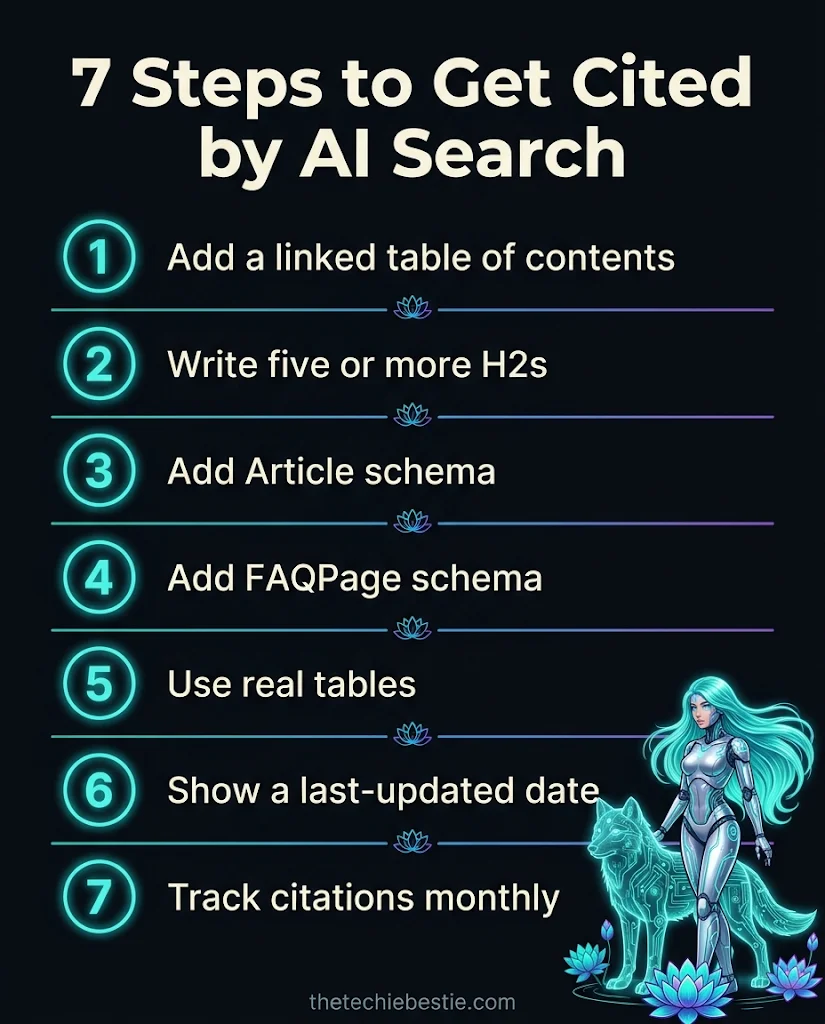
How to Get Cited by AI Search in 7 Steps
- 1.Add a linked table of contents. Put it near the top of every long post and guide, with jump links to each H2. Build it into the template once so every page gets it.
- 2.Write five or more descriptive H2s. Each H2 should name what the section answers. Phrase two or three of them as the questions people type into ChatGPT.
- 3.Add Article schema to every post. Follow Google's Article structured data guide and include the author, the publish date, and the modified date.
- 4.Add FAQPage schema where you have a real FAQ. Google limits FAQ rich results to a few site types, but the markup still labels your questions and answers for machines.
- 5.Put at least one real table on key pages. Use a header row, units, and plain labels. ChatGPT cited pages with header-row tables 1.8 times as often.
- 6.Show a visible last-updated date. Only 5% of pages in the study did, which makes it an easy way to stand out. Update the date only when you change the content.
- 7.Track citations by engine every month. Run your top 20 prompts in ChatGPT, AI Mode, and AI Overviews, log which pages get cited, and fix the gaps first. Leave llms.txt at the bottom of the list.
Do not pile on Product schema expecting AI wins either. It scored 0.5x in AI Overviews, likely because shopping answers pull from other sources, so pair product pages with a comparison guide that has its own table of contents.
Want me to score your top 20 pages against these factors? Book a strategy call or see packages and pricing. If the acronyms still blur together, start with GEO vs SEO vs AEO.
Key Takeaways
- ●A SISTRIX study of 96,418 pages, published October 22, 2026, compared cited and uncited pages from the same sites across ChatGPT, AI Mode, and AI Overviews.
- ●A linked table of contents lifted AI citations 1.7x, more than any schema type, and only 14% of pages had one.
- ●Article schema (1.6x), five or more H2s (1.6x), FAQPage schema (1.5x), and header-row tables (1.8x in ChatGPT) all helped.
- ●llms.txt showed no measurable effect on AI citations, so it belongs at the bottom of your list.
- ●Pages that met many of the core criteria were cited 2.1x as often, so stack the fixes on every key page.
Frequently Asked Questions
Does llms.txt help you get cited by ChatGPT?
Not in the data so far. A SISTRIX study of 96,418 pages, published October 22, 2026, found no measurable effect on AI citations, with only 11.7% of cited pages coming from domains with an llms.txt file, against 14.0% across all domains. Structure, like a linked table of contents and schema, mattered more.
What page features get cited most by AI search?
In the SISTRIX study, a linked table of contents had the biggest lift at 1.7x. Article schema and five or more H2 headings followed at 1.6x, then FAQPage schema at 1.5x and question-style H2s at 1.4x. In ChatGPT specifically, pages with a table that has a header row were cited 1.8x as often.
Does schema markup help with AI Overviews citations?
Yes, depending on the type, since Article schema was linked to 2.0x as many Google AI Overviews citations in the SISTRIX study. Product schema scored 0.5x in AI Overviews, and HowTo schema showed no lift. Use Article schema on every post and add FAQPage schema where the page has a real FAQ.
How many H2 headings should a page have for AI search?
Aim for five or more descriptive H2 headings on long content. Pages with at least five H2s were cited 1.6x as often overall and 1.8x as often in Google AI Mode in the SISTRIX study. Phrase some H2s as questions, because question-style headings showed a 1.4x lift.
Do I need a table of contents for SEO in 2026?
For AI search, yes, because a linked table of contents with jump links was the strongest single feature in a 96,418-page SISTRIX study, at 1.7x the citations. Only 14% of pages had one. It also helps readers jump to answers and gives Google clean section links to show in results.