Let me start with a simple experiment. Open ChatGPT, Claude, or Gemini. Type a question about your industry. Read the answer carefully. Notice something? There are no blue links to click. No page one, page two. Just an answer — synthesized, confident, and cited from sources you probably weren't aware were even being watched.
This is what search looks like now. And it changes everything about how brands need to think about visibility, authority, and content strategy.
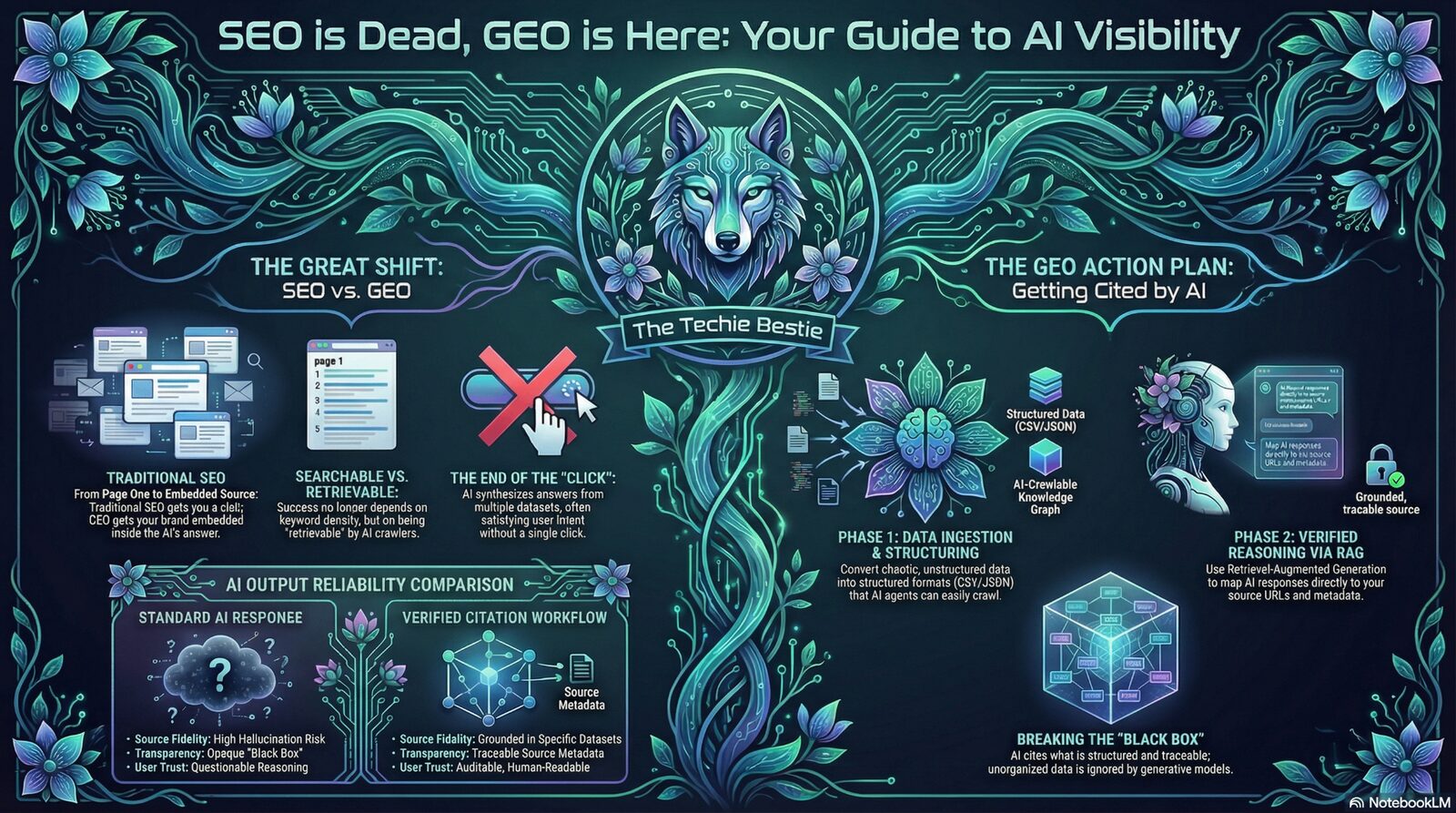
Traditional SEO got you on the first page. GEO gets your brand embedded inside the AI's answer. One gets you a visit. The other makes you the source.
How We Got Here
The evolution of search over the past three decades is one of the most consequential and underappreciated stories in technology. It didn't happen all at once. It happened in incremental shifts — each one rewriting the rules of online visibility.
The SEO Timeline: 1994 to Now
1994–1998: Web Directories & Meta Tags — Yahoo, AltaVista, keyword stuffing. Say "furniture" 40 times, rank for furniture.
1998–2003: PageRank Revolution — Google enters. Backlinks become ranking currency. Who links to you matters more than what you write.
2003–2010: Anti-Spam Era — Florida Update, Panda, Penguin. Manipulation gets penalized. Quality content starts to win.
2011–2015: Semantic Search — Hummingbird, Knowledge Graph. Google understands intent. Topic relevance overtakes keyword density.
2016–2019: Mobile-First & UX Signals — Mobile-first indexing, Core Web Vitals. User experience becomes a ranking factor.
2019–2022: AI Ranking Systems — RankBrain, BERT, passage indexing. Neural networks enter the algorithm.
2023–2024: Generative AI Search — AI Overviews, conversational answers, zero-click searches proliferate.
2025–2026: Generative Engine Optimization (GEO) — LLM citations, structured data for RAG, entity authority, explainable AI alignment.
Notice the trajectory. Every few years, the rules shift — not because Google changed a policy, but because the underlying technology changed what "understanding" a document even means. We've moved from matching keywords, to following links, to comprehending meaning, to generating answers. Each transition made the previous strategy partially obsolete.
GEO is the current transition. And it's the most fundamental one yet.
The Mechanics — What AI Search Actually Does
To optimize for something, you need to understand how it works. Here's what's happening under the hood when an AI search tool answers a question:
Traditional search ranked documents. AI search synthesizes answers. It pulls from multiple sources — articles, product databases, structured data, scraped social platforms — and generates a coherent response. The sources don't all get equal treatment. Structured, retrievable, high-authority data gets cited. Messy, unstructured content gets ignored.
This happens through a technical architecture called RAG: Retrieval-Augmented Generation. Here's how the pipeline works:
Phase 1 — Data Ingestion: Web scrapers crawl platforms like Reddit and Twitter for raw content. Raw JSON gets converted into structured Google Docs or CSVs. Structured data gets indexed for AI querying.
Phase 2 — AI Retrieval: RAG queries the indexed data through semantic search. LLM generates a response mapped to source URLs and metadata. Every answer is traceable, cited, grounded — not hallucinated.
The difference between ending up in column A or column B of this process comes down to one thing: whether your content is structured and retrievable, or whether it's just floating in the general internet as unindexed noise.
The Problem — The Black Box and Why It Matters for Your Brand
AI researchers call it the "black box" problem: traditional deep learning models generate answers without showing their reasoning. They're opaque by nature. The fix — and this is important — is something called the Explainability Barrier.
The explainability barrier is where LLM creativity meets rigorous, deterministic logic. It's the conceptual layer where chaotic unstructured data — scattered documents, messy notes, randomized data points — gets transformed into structured, auditable, human-readable output through frameworks like Question-Option-Criteria (QOC).
Standard AI has high hallucination risk, an opaque black box, and is limited to training cutoff. A citation workflow is grounded in specific datasets, uses traceable URLs, and works with real-time content.
The brands that get cited by AI aren't just the ones with the most content. They're the ones whose content exists below the explainability barrier in an organized, structured, parseable form. If your content is in the "chaotic unstructured" pile, AI won't cite you. It simply can't.
The Strategy — How to Make Your Brand AI-Retrievable
This is the part you came for. GEO strategy breaks into two phases, and both are necessary.
Phase 1: Optimize for the AI Crawl
Dominate high-authority data sources. Platforms like Reddit and Twitter are frequently scraped to build AI training datasets. An active, authoritative presence on those platforms — genuinely helpful answers, consistent topical expertise — gets you into the base layer of AI knowledge. This is the new "first page."
Leverage keyword enmeshment for topical authority. This isn't keyword stuffing. It's about becoming the definitive entity in your niche. Tools like Ahrefs can surface the clusters of keywords AI agents prioritize when building topical authority. You want to own a cluster, not just rank for a phrase.
Use explainable content structures. The QOC framework — Question, Options, Criteria — is the most practical tool here. For every piece of content you create, be explicit: what question does this answer? What options does it evaluate? What criteria does it use? That structure is directly parseable by LLMs.
Practical starting point: Audit one piece of existing content through the QOC lens today. What's the core question it answers? Does it explicitly lay out the options? Does it articulate the criteria for evaluation? Restructuring with these three elements alone makes content dramatically more AI-readable.
Phase 2: Build Technical Accessibility
Implement the Model Context Protocol (MCP). MCP is an open protocol that grants AI tools direct, structured access to your brand's unique data. Think of it as an API purpose-built for LLMs. If you have proprietary data — research, product information, expert analysis — MCP is how you make it available for AI retrieval without giving everything away publicly.
Deploy RAG-ready datasets. Convert your brand insights into shareable, structured documents — Google Drive works well — formatted for AI-powered analysis. The key is structure: clear headings, consistent metadata, defined sources.
Automate via n8n workflows. Freshness matters. Stale data doesn't get retrieved as readily as current data. Automated pipelines using tools like n8n can feed updated brand content directly into LLM-linked tools on a regular cadence.
The Framework — The Three-Layer GEO Stack
Layer 01 — Presence: Web scrapers capture your content for base knowledge. High-authority social presence on scraped platforms. Topical authority via keyword enmeshment.
Layer 02 — Integration: Real-time retrieval via n8n and MCP pipelines. RAG-ready structured datasets. Automated freshness pipelines.
Layer 03 — Authority: Entity authority via Ahrefs and Gemini optimization. QOC content structures for LLM interpretability. Consistent citation across AI responses.
The Goal: Move from "searchable" to "retrievable" by AI agents. Become a trusted, cited source inside AI answers. Own your niche in the AI knowledge base.
The Verdict — What Happens to Brands That Don't Adapt
I want to be direct about this, because I think the stakes are often undersold. We've seen this movie before — with mobile optimization, with structured data, with voice search — and the pattern is always the same: early movers win disproportionately, and laggards spend years trying to catch up.
GEO is different in one key respect: the compounding effect is more severe. In traditional SEO, a brand that ranked on page three could still get traffic. In AI search, a brand that isn't cited simply doesn't exist in that answer. There's no page three. There's the answer, and there's everything else.
The window to build GEO infrastructure while the field is still relatively uncrowded is 2025 and early 2026. After that, the brands with established entity authority and structured data pipelines will be very hard to displace.
Your voice, your expertise, your perspective — those still matter. They're actually more important than ever. The difference is that they need to be packaged in a form that AI can find, parse, and cite. That's the translation work GEO requires.
The brands that treat their content as structured data assets — not just blog posts — are the ones that will own their space in the AI era.
Start with one piece of content. Apply the QOC framework. Publish on a platform that gets scraped. That's the first step. The infrastructure builds from there.
See you in the AI's knowledge base. ✦