Google just gave every marketer a new dashboard row to watch closely.
On May 13, 2026, Google Analytics added a dedicated "AI Assistant" channel to GA4''s Default Channel Group reports. It automatically identifies traffic from ChatGPT, Gemini, Claude, and other AI platforms and assigns it a new "ai-assistant" medium value, no custom setup required. If you log into GA4 today, your AI traffic data is already there.
This is not a minor reporting tweak. It is the first time AI-driven discovery has had its own native measurement lane in the tool that runs on the majority of the world's websites. And what you find in that channel will change how you allocate content resources for the rest of 2026.
What the GA4 AI Assistant Channel Actually Does
The update changes three traffic source dimensions simultaneously. The medium dimension now automatically assigns "ai-assistant" when GA4 detects a referrer matching a recognized AI assistant. Those sessions are grouped under the new "AI Assistant" channel in Default Channel Group reports. The campaign dimension labels all AI-sourced traffic with the reserved name "(ai-assistant)."
This happens automatically across every GA4 property. No configuration needed. No regex to build. No custom channel group to maintain.
The significance becomes clearer when compared to what came before it. Until now, Google Analytics guidance has told marketers to build custom channel groups using regex patterns to capture traffic from ChatGPT, Gemini, Microsoft Copilot, Claude, and Perplexity, a tedious process that most teams either implemented incorrectly or skipped entirely.
That workaround is now obsolete: ChatGPT just launched ads, what that means for your strategy. The official channel exists. Your AI traffic is measurable. The question is what to do with the data once you can see it.
What the Data Will Show You
The first thing most teams will notice: AI traffic is small but punches above its weight.
Research published by NP Digital found that 24.3% of marketers receive consistent referral traffic from AI tools, with another 39.3% reporting occasional traffic, a combined 63.6% rate of AI referral exposure across the marketing professional community.
The volume is still modest. ChatGPT sends approximately 190 times less traffic to websites than Google, despite handling roughly 12% of Google''s query volume. But the quality of that traffic is where the story gets interesting.
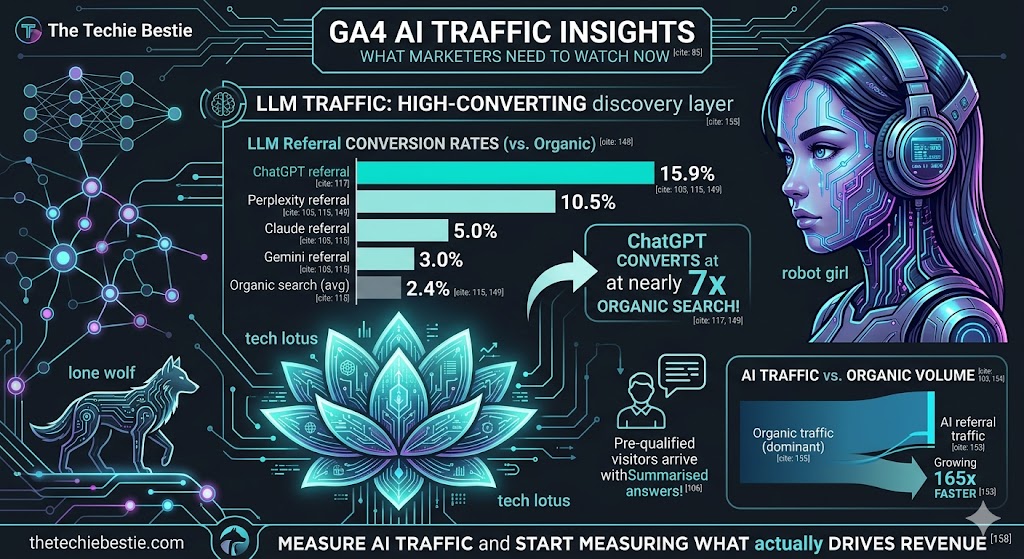
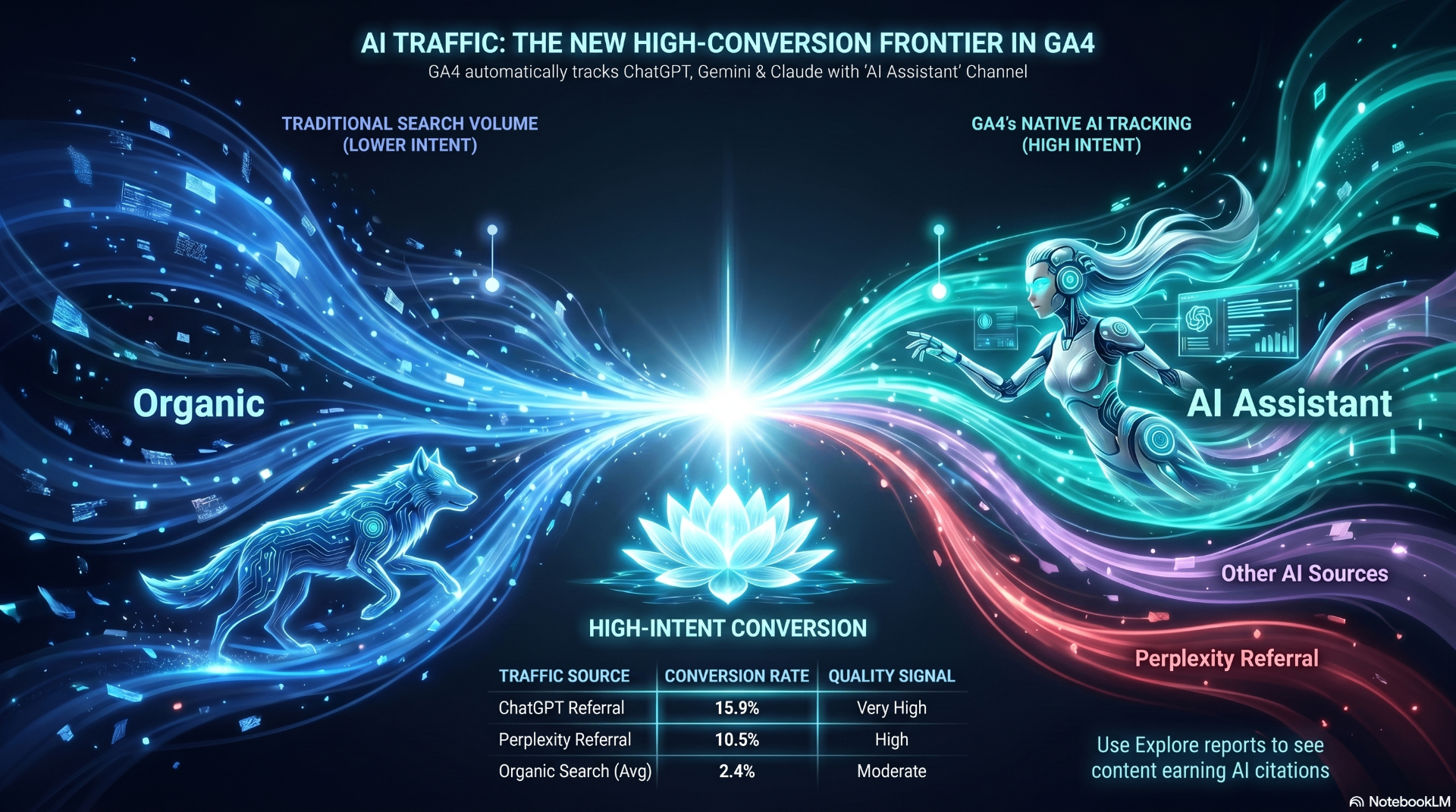
LLM traffic converts at significantly higher rates than organic search: ChatGPT at 15.9%, Perplexity at 10.5%, Claude at 5%, and Gemini at 3%. These visitors arrive pre-qualified. They have already received a summarized answer from an AI.
That intent signal is worth tracking obsessively.
What your GA4 AI Assistant channel will reveal:
- ●Which pages are earning AI citations and driving actual clicks
- ●Which AI platforms (ChatGPT vs. Claude vs. Gemini vs. Perplexity) send you traffic
- ●How AI-referred visitors behave compared to organic search visitors
- ●Which content types earn AI traffic versus which just rank in Google
AI Traffic Conversion Rates vs. Traditional Channels
Conversion Rate by Traffic Source (%)
Ahrefs, June 2025 / Position Digital AI SEO Statistics, May 2026
The conversion gap is not incremental. ChatGPT referral traffic converts at nearly 7x the rate of average organic search. If you are not tracking it, you are making content decisions without your highest-performing channel regarding data.
What Else Dropped This Week
Schema Markup Does Not Improve AI Citations
A study confirmed this week that adding schema markup does not improve AI citation rates. This contradicts advice that has been circulating widely. Schema remains important for Google rich results and structured snippets. Content structure, authority signals, and front-loaded answers are still the primary drivers.
Google Marketing Live is Six Days Away
Google Marketing Live 2026 takes place on May 20, 2026. The keynote will center on AI-powered campaign tools, agentic commerce capabilities inside Search and Shopping, and a new era of YouTube performance.
OpenAI is reportedly forecasting $2.5 billion in ad revenue by 2026. Microsoft recently introduced AI Max for Search with expanded query matching and personalized ads across Copilot and Bing. Adobe has replaced Experience Cloud with CX Enterprise and introduced persistent AI agents called "Coworkers."
The pattern is clear: every major ad platform is converting AI from a feature into infrastructure.
For PPC teams, the practical question for May is no longer "should we test Performance Max?" It''s "how do we keep human judgment in the loop when the platforms increasingly want to take it out?"
Vibe Coding as an SEO Advantage
The biggest SEO gains increasingly come from interactive experiences that remove friction and answer intent immediately. Tools like Replit and Claude Code are now allowing non-technical marketers to build interactive tools, calculators, and data visualizations that earn links and citations at rates that static blog posts cannot match.
What to Do in Your GA4 Right Now
The AI Assistant channel update was published to the Google Analytics Help Center on May 13, 2026. The three-part change affects the medium, channel group, and campaign dimensions simultaneously, all without requiring any action from the property owner.
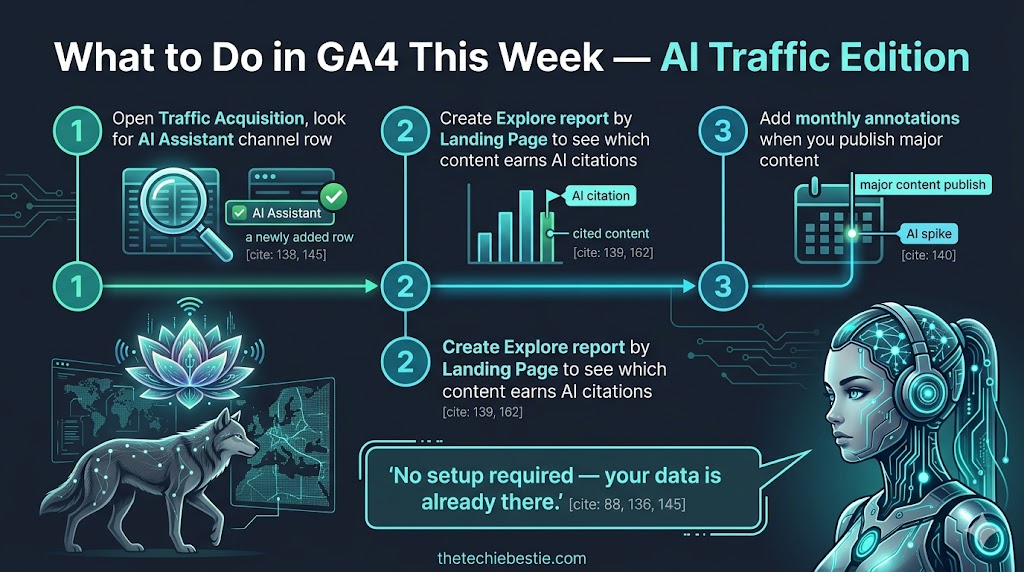
You do not need to do anything to activate it. But you should do these three things to actually use it:
- ●Open GA4 today and check Traffic Acquisition for the new "AI Assistant" channel row.
- ●Create an Explore report segmenting AI Assistant traffic by landing page. This tells you which content is earning citations.
- ●Set a monthly annotation when you publish major content so you can correlate publish dates with AI referral spikes.
One caveat worth knowing: AI traffic from Google AI Overviews is still merged into Organic Search in GA4 and is not captured by the new channel. ChatGPT mobile app traffic and traffic from the ChatGPT Atlas browser also default to Direct, not the AI Assistant channel. The new channel captures a meaningful portion of AI traffic, not all of it.
FAQ: GA4 AI Traffic and May 2026 Updates
Does the GA4 AI Assistant channel require any setup? No. Google Analytics automatically assigns the "ai-assistant" medium and groups sessions under the AI Assistant channel when it detects a referrer matching a recognized AI assistant like ChatGPT, Gemini, or Claude.
Does schema markup help get cited in AI search? A study published this week found that adding schema markup does not improve AI citation rates. Schema remains useful for Google rich results and structured snippets, but does not directly influence AI citation frequency.
What converts better, AI traffic or organic search? AI referral traffic converts at significantly higher rates. ChatGPT referral traffic converts at 15.9% and Perplexity at 10.5%, compared to an average organic search conversion rate of roughly 2.4%.
What is Google Marketing Live 2026 announcing? Google Marketing Live 2026 on May 20 is expected to unveil AI-powered campaign tools, agentic commerce capabilities inside Search and Shopping, and new YouTube performance formats. It follows Google I/O on May 19-20 and is the biggest advertising announcement event of the year.
Will AI traffic eventually replace organic search traffic? Not yet. AI traffic is growing 165x faster than organic search traffic, but it remains a small absolute volume. ChatGPT sends approximately 190 times less traffic than Google, despite handling 12% of Google''s query volume. Organic search remains the dominant channel, but AI traffic is the highest-converting discovery layer available right now.
What does OpenAI''s product feed ads mean for SEO? OpenAI is turning product catalogues into automated ads inside ChatGPT, making it easier for retailers to scale paid campaigns on the platform. It signals that the organic-first window inside AI platforms is narrowing, and brands that establish citation authority now will have a lower cost-per-inclusion once paid auctions dominate.
Start Measuring What Actually Drives Revenue
The GA4 AI Assistant channel update is a turning point. For the first time, marketers can see their AI-sourced traffic in the same reporting interface as every other channel, without custom setup, without regex, without workarounds.
The data that comes out of that channel should directly inform where you put content resources next. High-converting AI referral traffic from a handful of well-structured, authority-forward pages will tell you more about your GEO strategy than any visibility score tool on the market.
The Techie Bestie SEO content strategy services build the content systems that earn those AI citations in the first place. I work with B2B brands in fintech, SaaS, construction, and beyond who are done guessing and ready to build for both traditional and AI search simultaneously.
More breakdowns like this on The Techie Bestie blog. Questions or ready to dig in? Book a strategy call.