On May 19, 2026, Google rebuilt the search box for the first time in 25 years, confirmed AI Mode has 1 billion monthly users, launched background information agents that run 24/7, and officially stated that GEO and AEO are not separate from SEO.
The most consequential thing Google said at I/O 2026 was not about Gemini 3.5 Flash, or AI Mode crossing a billion users, or the unified search box being the biggest upgrade in 25 years. It was that AI search optimization is not a new discipline. It is the same discipline. SimpleTiger
Both camps lost their argument simultaneously. The "SEO is dead" crowd and the "AI search is a sideshow" crowd are now both wrong. Here is what actually happened and what it means for your content and visibility strategy for the rest of 2026.
What Google Actually Announced at I/O 2026
On May 19, 2026, Google's Head of Search Liz Reid called the new intelligent Search box "the biggest upgrade to our iconic search box since its debut over 25 years ago." The new experience does four things simultaneously: merges AI Overviews and AI Mode into a unified experience, sets Gemini 3.5 Flash as the default model, rebuilds the search box to accept text, images, files, videos, and Chrome tabs, and adds persistent background AI agents directly to Search. The Digital Hall
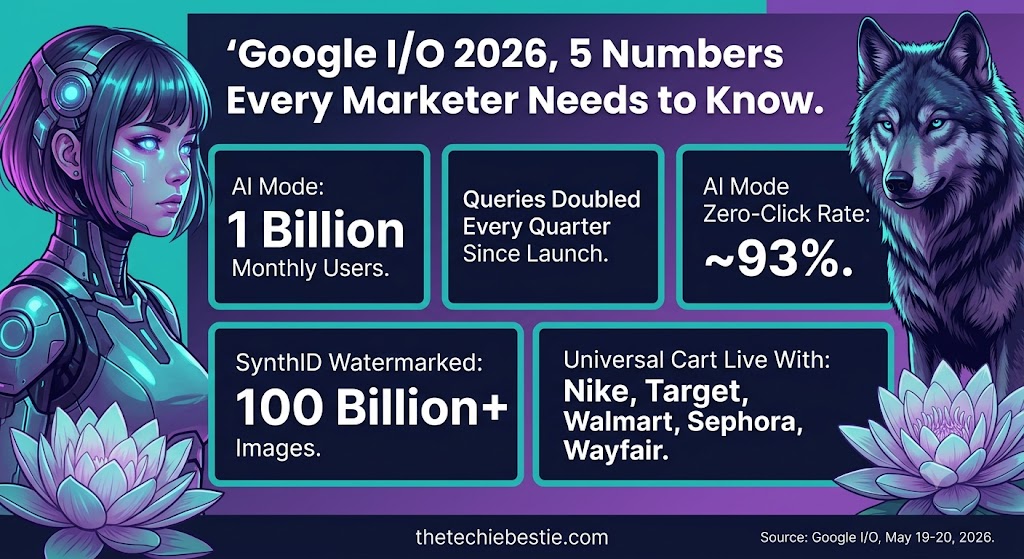
AI Mode has passed 1 billion monthly users. Queries have more than doubled every quarter since launch. This is no longer an experiment. It is the primary search surface for a growing share of your target audience. Getpassionfruit
The five announcements that matter most for SEO and content professionals:
- ●Gemini 3.5 Flash is now the default AI Mode model globally, faster, more capable, and the engine powering every AI-generated answer your audience sees
- ●Information Agents now run 24/7 in the background, scanning blogs, news, and social posts on behalf of users and delivering synthesized updates without requiring a new search Google
- ●SynthID verification is now live in Search through Lens, AI Mode, and Circle to Search, users can ask "Is this made with AI?" and get a verified answer Quartz
- ●Universal Cart now enables checkout inside Google AI, with launch partners Nike, Target, Walmart, Sephora, and Wayfair, the full purchase journey moves inside Google
- ●May 2026 Core Update launched May 21 simultaneously with I/O, Semrush Sensor is showing significant volatility, making attribution of any ranking changes in the next two weeks complex Kulbhushan Pareek
Google's Official Position, GEO and SEO Are the Same Thing
This is the most important strategic clarification of 2026 for anyone selling or buying SEO services.
Google's May 15, 2026 official guide, published through Google Search Central, states clearly that AEO and GEO are not separate disciplines. They are foundational SEO applied to an AI surface. The recommendation is to maintain strong technical SEO, produce unique expert-led content, and follow existing best practices. No separate AI-specific optimization layer is required.
Strong foundational SEO applied to AI surfaces is the complete framework.
This matters enormously for how you position content strategy to clients. You are not selling "GEO services" as a premium add-on. You are selling total search visibility, one system that earns citations in Google, AI Mode, ChatGPT, Perplexity, and Claude simultaneously. The underlying work is the same. The measurement and framing expand.
Read GEO vs SEO in 2026: What Every Business Owner Needs to Know for the full breakdown of how these layers fit together.
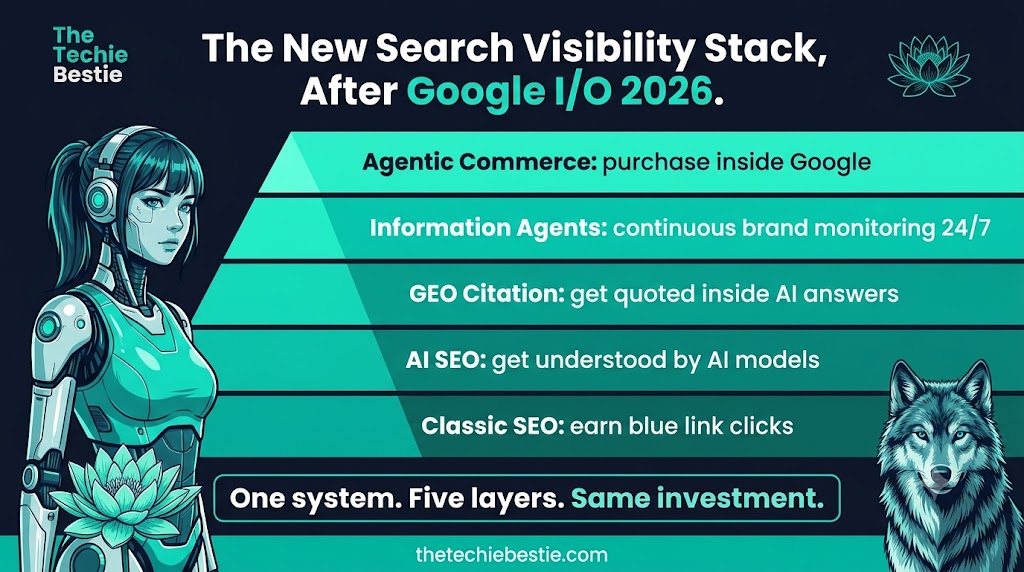
The New Search Visibility Stack After I/O 2026
| Visibility Layer | What It Earns | Primary Driver | Where It Shows |
|---|---|---|---|
| Classic SEO (rank) | Blue link clicks | Technical SEO + E-E-A-T + backlinks | Google organic results |
| AI SEO (understanding) | Inclusion in AI answer pool | Structured content + entity clarity | AI Mode, AI Overviews |
| GEO (citation) | Being quoted inside AI answers | Authority + front-loaded answers + 3rd-party coverage | ChatGPT, Perplexity, Claude, AI Mode |
| Information Agent visibility | Continuous brand monitoring by user agents | Fresh, accurate, machine-readable content | Background agents (Summer 2026) |
| Agentic commerce | Purchase inside Google | Structured product/service data + UCP integration | Universal Cart |
Source: Google I/O 2026 and Google Search Central official guide, May 15 to 19, 2026
Winning means combining SEO, AI SEO, and GEO so you rank, get understood, and get cited. These are not three budgets. They are three layers of the same investment.
The Information Agents Announcement Changes Everything for Brand Strategy
This is the most underreported announcement from I/O 2026.
Information agents are AI agents that run in the background, 24/7. A user describes what they are looking for. The agent continuously scans the web, blogs, news sites, social posts, real-time finance, shopping, and sports data, and delivers an intelligent synthesized update when relevant content appears. The user can then take action from that update without running a new search.
Your audience now includes their agents. These agents check your site repeatedly, looking for changes. This means consistent content publishing that targets both traditional keyword queries and conversational AI Mode query patterns is more important, not less.
The implication for content strategy is significant. Publishing cadence is now a brand visibility signal, not just an engagement tactic. If a user's agent is monitoring "AP automation news" or "B2B SaaS content strategy" and your site has not published anything fresh this week, your brand does not appear in their agent's synthesized update. You are invisible to the agent layer.
Content that earns information agent visibility:
- ●Fresh content published consistently on a 3 to 5 day cadence
- ●Specific named entities (tools, platforms, people, companies) in every post
- ●Clear, structured answers to questions AI agents are likely to synthesize
- ●Publication dates visible on every piece of content
- ●Accurate, current data, not evergreen generalities
SynthID and the AI Content Transparency Era
At Google I/O 2026, Google enabled users to ask whether an image is AI-generated directly in Search via Lens, AI Mode, and Circle to Search. This checks the SynthID watermark and the open C2PA Content Credentials standard. This is media provenance, not a penalty on AI-written article text. Google did not announce any signal that detects or penalizes AI-written text in ranking.
What this means practically:
- ●AI-generated visuals are fine when they genuinely help the reader and are disclosed honestly. Do not strip SynthID watermarks or pass them off as photographs.
- ●Brands publishing AI-generated visual content without watermarking or content credentials face increasing visibility as AI-content publishers when users query provenance.
- ●On high-trust, high-intent pages, services pages, case studies, about pages, original photography now carries a verifiable authenticity advantage.
- ●Blog illustrations, infographics, and concept images generated by Gemini or Midjourney are fine. Use them where provenance is less critical.
SynthID can only detect content watermarked with SynthID. Content from tools that have not adopted the standard will not be flagged. The system's usefulness grows with adoption across the industry.
What This Means for Your Verticals
Fintech and AP Automation
Information agents monitoring "accounts payable automation" or "invoice processing news" will surface brands with consistent, fresh content. AP automation content that publishes 2 to 3 times per week with specific named entities earns agent visibility. Sparse publishing is now actively penalized by the agent layer, not just the algorithm layer.
B2B SaaS
AI Mode means visibility depends less on keyword ranking alone and more on being clearly understood, trusted, and cited by AI systems. The modern version of search requires being findable in Google, understood by AI platforms, credible on LinkedIn, proven on YouTube, validated by reviews, and supported by case studies. The SaaS brand that earns AI Mode citations today owns the consideration set before the first sales touchpoint.
Restaurants and Local Businesses
Information agents that can help users find and contact local service providers will roll out in the US during summer 2026. If a potential customer asks an AI agent to find and contact a provider, incomplete service details or outdated contact information means your business is skipped entirely, not just ranked lower. NAP accuracy, structured hours, and service descriptions become agent-readability requirements.
Construction
Universal Cart and agentic checkout expand into physical goods and service scheduling during 2026. Construction supply brands, equipment rental companies, and material suppliers with structured product data will earn Universal Cart inclusion. Those without structured data will not.
FAQ, Google I/O 2026 and What It Means for SEO
Is GEO now separate from SEO?
No. Google's official May 15, 2026 guide published through Google Search Central Blog confirmed that AEO and GEO are not separate disciplines. They are foundational SEO applied to an AI surface.
How many people use AI Mode?
As of Google I/O 2026 on May 19, AI Mode has passed 1 billion monthly active users. Queries have more than doubled every quarter since launch.
What are Information Agents and when do they launch?
Information agents are background AI agents that scan the web 24/7 on a user's behalf, delivering synthesized updates when relevant content appears. They launch for US-based Google AI Pro and Ultra subscribers in summer 2026.
Does SynthID penalize AI-written content?
No. Google did not announce any signal that detects or penalizes AI-written text in ranking. SynthID checks whether images, video, and audio were AI-generated. Google's standing policy is that helpful, people-first content is fine regardless of whether AI assisted in creating it.
What happened with the May 2026 Core Update?
The May 2026 Core Update launched May 21, simultaneously with I/O. Semrush Sensor is showing high volatility. If you have seen ranking changes between May 21 and June 2, your site was likely impacted.
What is the Universal Cart?
Universal Cart is Google's agentic shopping layer built on the Universal Commerce Protocol. It enables checkout directly inside Google AI. Launch partners include Nike, Target, Walmart, Sephora, and Wayfair. It is currently live in the US with Canada and Australia expanding soon.
Three Actions This Week
The worst response to an overwhelming news week is paralysis. Here are the three highest-impact moves based on I/O 2026:
- 1.Check your robots.txt for AI crawler access. OAI-SearchBot, ClaudeBot, and PerplexityBot must not be blocked. Information agents need to crawl your site.
- 2.Add or update your llms.txt file. A structured text file at your root domain that tells LLMs about your site, its purpose, and its key pages is now a recognized GEO signal per Google's official guidance.
- 3.Audit your content freshness. Every page on your site should have a visible publication date and a stat published within the last 90 days. Information agents deprioritize stale content.
My SEO content strategy services build visibility systems that work across every layer, classic Google, AI Mode, ChatGPT, Perplexity, and Claude simultaneously. See pricing or book a strategy call to audit where your brand stands before the agent layer goes live this summer.