This week, OpenAI opened its self-serve ad manager for ChatGPT. Google ran ads in 25.5% of AI Overview results. Perplexity is testing sponsored questions again.
The organic window inside AI search is still open. The data from this week confirms it is not staying that way much longer, and the brands that do not act now will pay to appear later.
Here is what dropped this week and what it means for your content strategy.
Google's Core Update Just Rewrote the Visibility Playbook
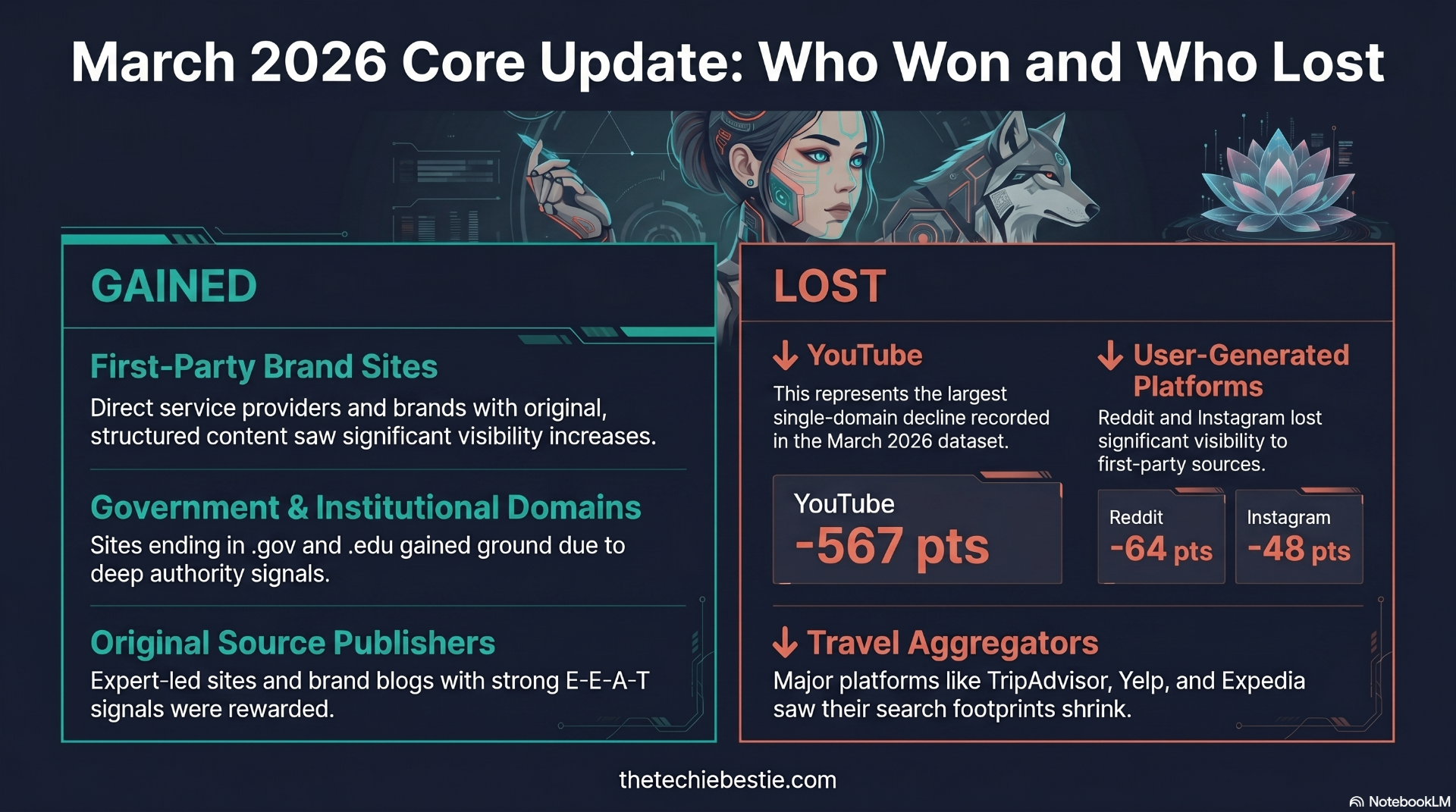
Google's March 2026 core update analysis by Lily Ray, using SISTRIX data from 2,000+ domains, showed major visibility losses for aggregators and user-generated content sites, while first-party brands and government websites saw gains. YouTube dropped 567 visibility points, the largest single-domain decline in the dataset. Search Engine Journal's reporting on Google's AI link updates breaks down how the new linking behavior is reshaping referral patterns at the same time.
This is not a minor shuffle. It is a structural signal. The data tells a consistent story across analytics platforms throughout 2025 and into 2026: positions one through three no longer guarantee the traffic volumes they once did when AI-generated summaries absorb user intent at the top of the page. Google Search Central's own guidance reinforces that original, helpful, first-party content is the throughline of every recent ranking change.
What gained ground in this update:
- ●First-party brand sites with original, structured content
- ●Government and institutional domains with deep authority signals
- ●Hotel chains and direct service providers over OTA aggregators
- ●Sites with strong E-E-A-T signals and expert attribution
What lost ground:
- ●YouTube, Reddit, Instagram, and X, all dropped measurable visibility points
- ●Travel aggregators including TripAdvisor, Yelp, and Expedia
- ●Thin content sites relying on syndication or content aggregation
- ●Pages with no clear first-party expertise signal
The effects of the March 2026 core update are still rippling through the SERPs. Nearly 80% of top 3 results shifted positions, and over 90% of top results saw movement during the 12-day rollout window.
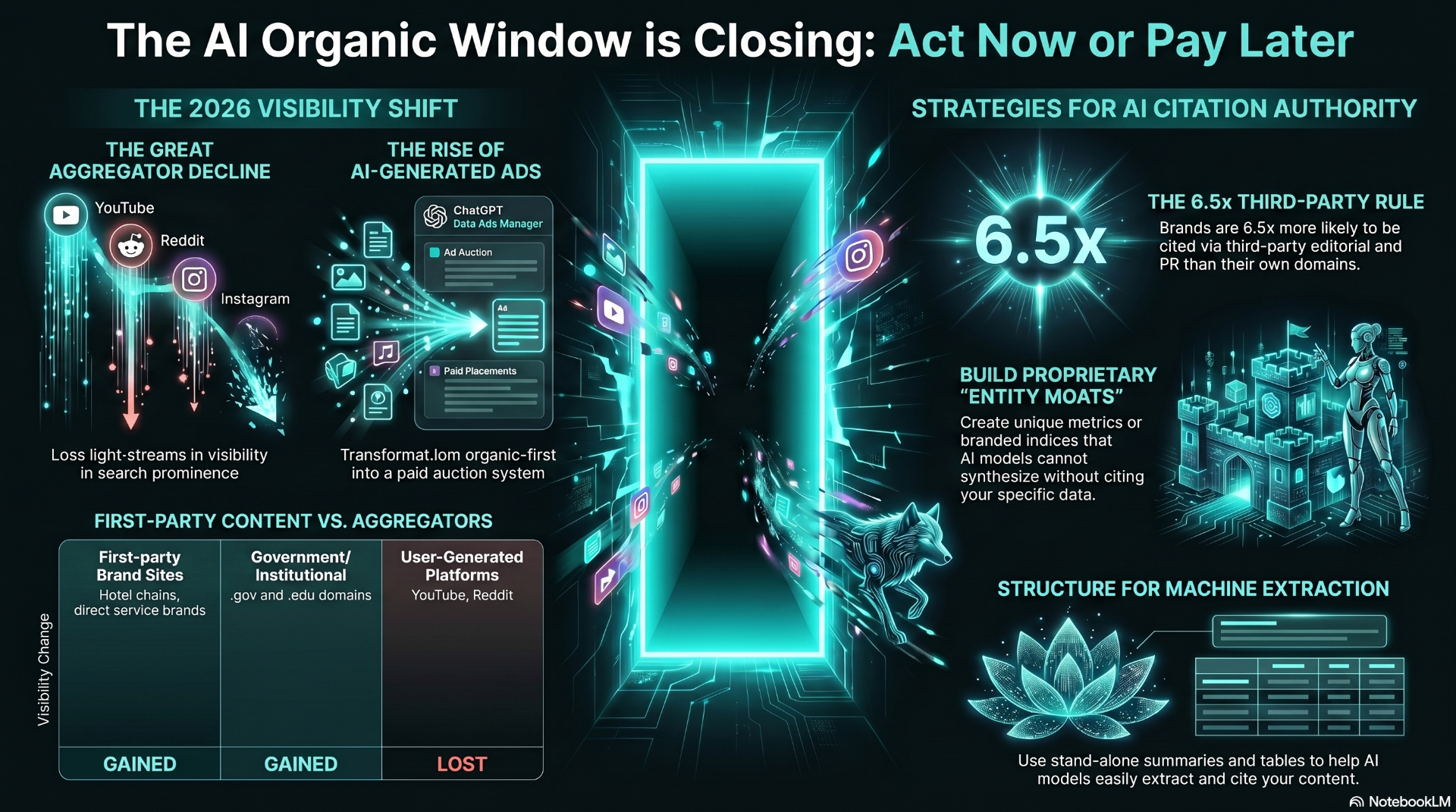
The Ads Are Coming, and the Organic Window Is Measured in Months
OpenAI officially launched its beta self-serve Ads Manager this week, letting US advertisers buy ads directly inside ChatGPT, mirroring Google's early shift from organic discovery to ad auctions in 2003. Search Engine Land's AI search visibility predictions lay out how quickly that auction layer is expected to expand across every major answer engine.
One SEO leader framed it directly: "Ads are coming, but the window is now. Google runs ads in AI Overviews across 12 countries, and they're testing in AI Mode. ChatGPT shopping is 'organic and unsponsored' today. Their CFO says ads are coming. Same pattern as early Google. Organic visibility now means dominant position when the auction opens."
The brands that establish AI citation authority now will pay less and win more when paid placements go live across every platform. The brands that wait will bid against each other for inclusion that they could have earned for free.
Chart, AI Search Visibility Shifts, March Core Update 2026
Domain visibility point shifts from the March 2026 Google Core Update, the largest single-domain movements tracked across 2,000+ domains.
Largest Visibility Losses, March 2026 Core Update
Source: Amsive analysis via Lily Ray, SISTRIX Visibility Index, May 2026. First-party brand sites, .gov / .edu domains, and expert-led publishers gained ground in the same window.
This chart tells you exactly where Google is sending traffic right now. If your content strategy depends on aggregator traffic, PR mentions on Reddit, or YouTube referrals, your funnel is leaking.
What Is Actually Driving AI Visibility Right Now
The unified message from SEO Week 2026 was direct: what actually drives AI visibility is editorial coverage, media mentions, bylines, PR, and community presence, all the stuff SEOs traditionally left to someone else. The concept of siloing these focuses is dead. iPullRank's roundup of the best quotes from SEO Week 2026 captures this shift in the exact words of the practitioners leading it.
The latest data reinforces this: brands are 6.5x more likely to be cited in AI search through third-party sources than through their own domains. ChatGPT only cites 50% of the pages it retrieves, and 88% of those cited URLs come directly from search results. Position Digital's 2026 AI SEO statistics compile dozens more benchmarks worth bookmarking if you report on AI visibility.
Three things that are working right now based on this week's research:
- ●Build entity moats. Brands that own a unique metric, a "[Brand] Index" or "[Brand] Score", create a source of truth that AI models cannot synthesize or ignore. Name your data. Publish your proprietary findings.
- ●Target third-party coverage. Your own blog is not enough. You need bylines, citations, and mentions in publications that AI already trusts. Semrush's new AI PR Toolkit reveals which outlets are most frequently cited by AI engines. Enter any topic and see which publications carry the highest AI Trust score.
- ●Structure for extraction. A citation-ready page gives one clear answer per section, supports claims with evidence, and uses headings, tables, and concise summaries that can stand alone. That structure improves machine extraction and conversion simultaneously.
Cutting-Edge Tools No One Is Talking About Yet
Most SEOs are still using the same stack from 2024. Here are the tools worth testing right now:
- ●AthenaHQ. Built by ex-Google Search and DeepMind engineers. Tracks your citation frequency across ChatGPT, Perplexity, and AI Mode with actual share-of-voice data. This is the measurement layer the industry has been missing.
- ●AlsoAsked. Maps query fan-out behavior. AI engines like ChatGPT and Google AI Mode use query fan-out to break a user's question into smaller sub-questions before generating a final answer. AlsoAsked gives you a way to see that process in advance. Build content that answers the sub-questions and you get cited in the full answer.
- ●Gauge. Full-stack GEO monitoring with an agentic content engine. It tracks mentions across all four major LLMs simultaneously and generates optimized content to close visibility gaps. The LinkedIn outreach integration to directly contact authors of AI-cited sources is genuinely new.
- ●Semrush AI Visibility Toolkit. Now live as a $99/month add-on. Tracks brand Share of Voice inside AI-generated answers and correlates mention frequency with sentiment. If you are reporting AI visibility to clients, this is the most defensible data available right now.
FAQ, May 2026 AI Search Update
What happened to Reddit and YouTube in the March 2026 core update? Reddit lost 64 SISTRIX visibility points, and YouTube lost 567 points, the largest single-domain drop in the dataset, roughly 30% larger than Wikipedia's decline in December 2025. Both platforms saw some rebound after the rollout window closed.
Can you buy ads inside ChatGPT now? Yes. OpenAI officially launched its beta self-serve Ads Manager this week, allowing US advertisers to purchase placements that appear inside ChatGPT responses. The program is in beta and invite-only as of May 2026.
Does your own website help with AI citations? Less than you might expect. Brands are 6.5x more likely to be cited through third-party sources than their own domains. Third-party editorial coverage, PR, and bylines outperform owned content for AI citation rates.
What does Google's Preferred Sources feature do? Google's Preferred Sources feature allows users to tell Google which publishers they trust, influencing which sources appear in their personalized AI search results. First-party original content creators benefit most from this feature.
Is traditional SEO still relevant in 2026? Total global search usage combining search engines and AI tools has grown by 26% worldwide as of March 2026. AI systems still depend on Google's index to understand the world, and content that ranks well in traditional search tends to earn AI citations as well. The two strategies are aligned, not competing.
What is query fan-out, and why does it matter? Query fan-out is the process AI engines use to break a user's question into smaller sub-questions before generating a final answer. Mapping those sub-questions in advance, using tools like AlsoAsked, lets you structure content that gets cited in the full synthesized response.
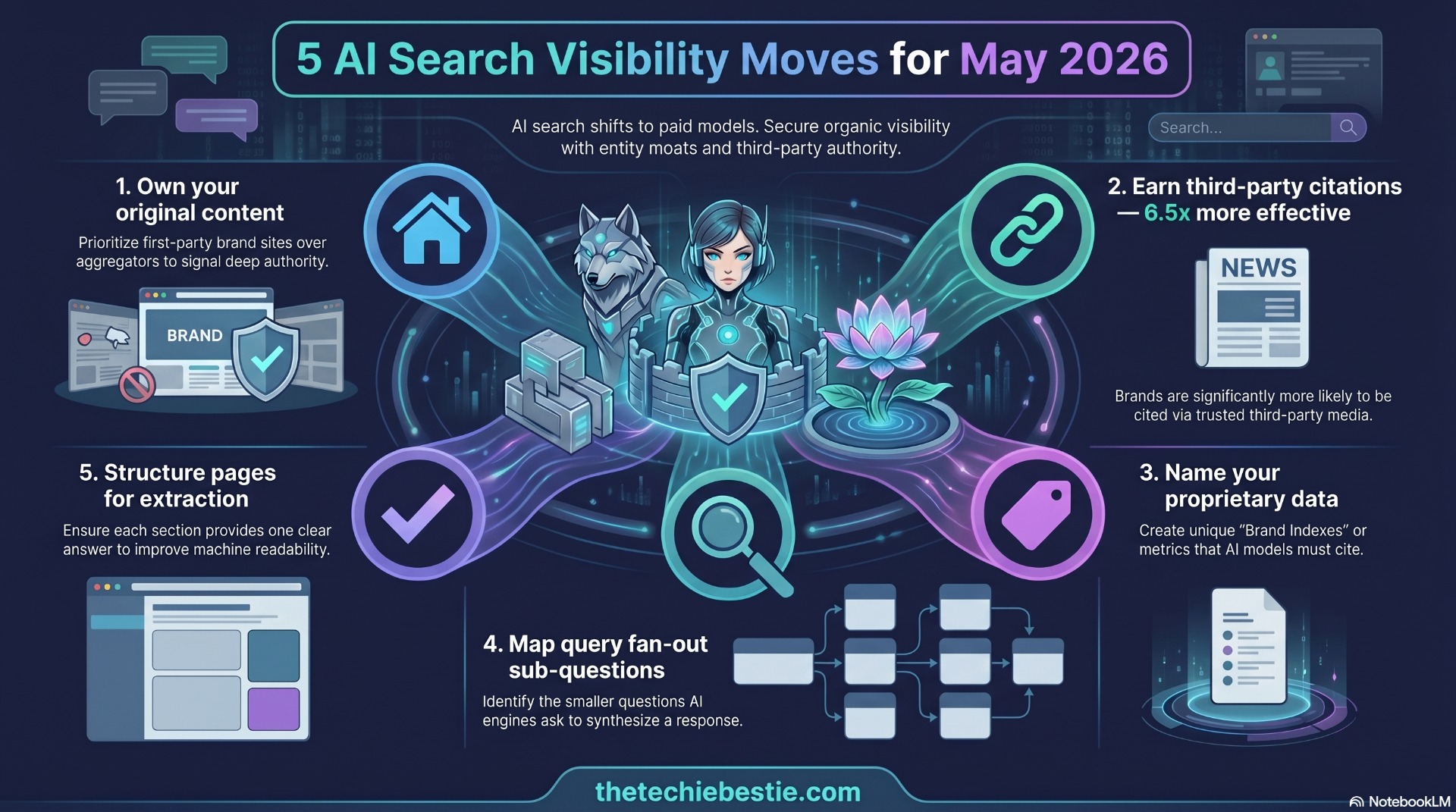
What to Do This Week
The March core update, the ChatGPT ad launch, and the inline link rollout all point to the same conclusion. The brands that control their own content, build third-party authority, and structure pages for machine extraction are gaining ground. Everyone else is losing it.
The Techie Bestie SEO content strategy services are built for exactly this environment. I build content systems that win in both traditional search and AI citation simultaneously, for fintech, B2B SaaS, construction, restaurants, and more.
Want to compare the disciplines side by side? Read GEO vs SEO in 2026 and The 5 Game-Changing SEO Trends You Need to Know in 2026. Then book a strategy call or explore pricing to audit your current visibility before the ad auctions lock in your competition.