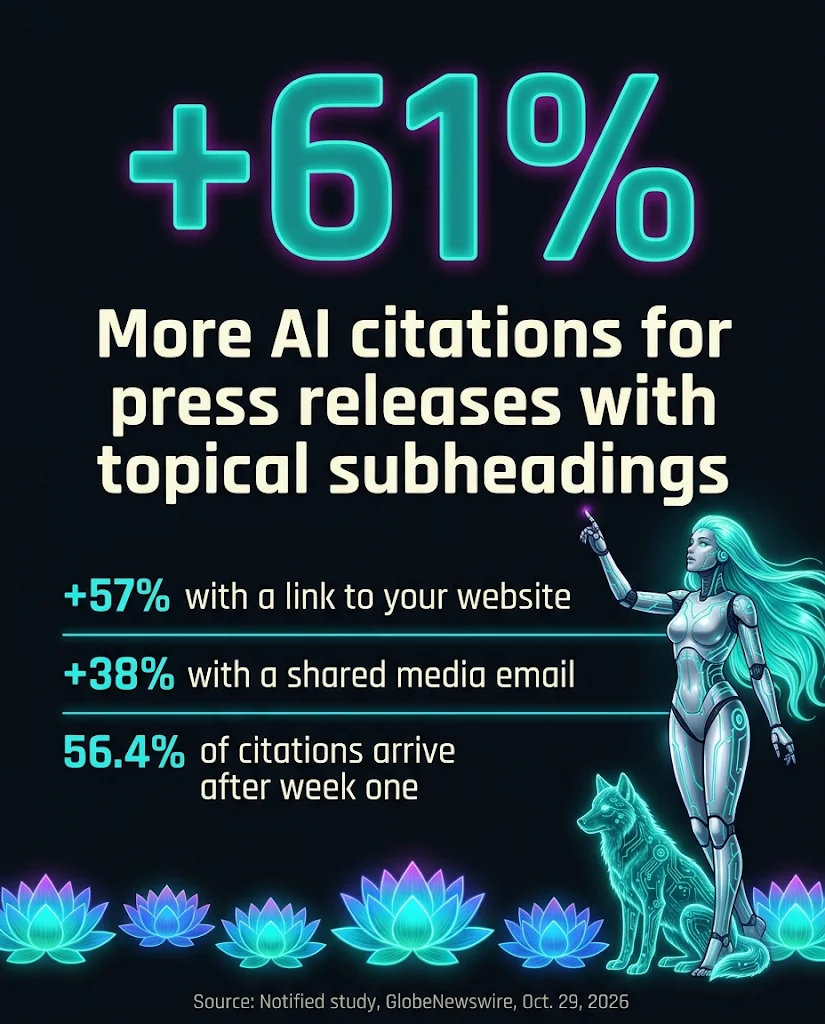
Press release AI citations jump when releases use topical subheadings. Notified's October 29, 2026 study found that releases with descriptive section headings earned 61% more citations from AI models. Structure, facts, and a link back to your site matter more than length.
Here is the number that surprised me: 56.4% of ChatGPT and Claude citations to these releases arrived more than a week after publication, up from 48.4% in April 2026. A press release is no longer a one-day news spike. AI engines keep pulling from it long after the wire, so the structure you publish with sticks around.
What the Notified Study Found About Press Release AI Citations
A press release AI citation is a link or attribution to your release inside an answer from an AI engine such as OpenAI ChatGPT, Anthropic Claude, Google AI Overviews, or Perplexity.
Notified, the company that runs GlobeNewswire, analyzed 26,670 English-language releases distributed in June and July 2026, plus comparison groups, covering more than 850,000 citation events. The headline of the same announcement rounds that to "25,000+" releases and "nearly 1 million" citations, so treat the exact sample size as approximate. Notified also describes every lift as an association, not proof that one feature caused more citations.
With that caveat in place, the pattern is clear. Here is what was tied to more, or fewer, AI citations:
- ●Topical subheadings: 61% more citations than releases without descriptive section headings.
- ●"First-of-its-kind" language: 60% more citations, which only helps when the claim is true and provable.
- ●A link to the company's own website: 57% more citations.
- ●A generic media email (like press@): 38% more citations, while listing only one person as the contact was tied to 12% fewer.
- ●High fact density: 29% to 33% more citations.
- ●FAQ sections: roughly neutral at minus 1.6%.
Speed and shelf life both moved too. In Notified's data, the median time to a first citation was 1.2 hours in ChatGPT and 46 hours in Claude. The share of releases cited by Claude rose from 33% in April 2026 to 64% in July 2026, and an October 15 Notified release first flagged that 56% of citations come after week one.
Chart: Which Press Release Features Earn More AI Citations
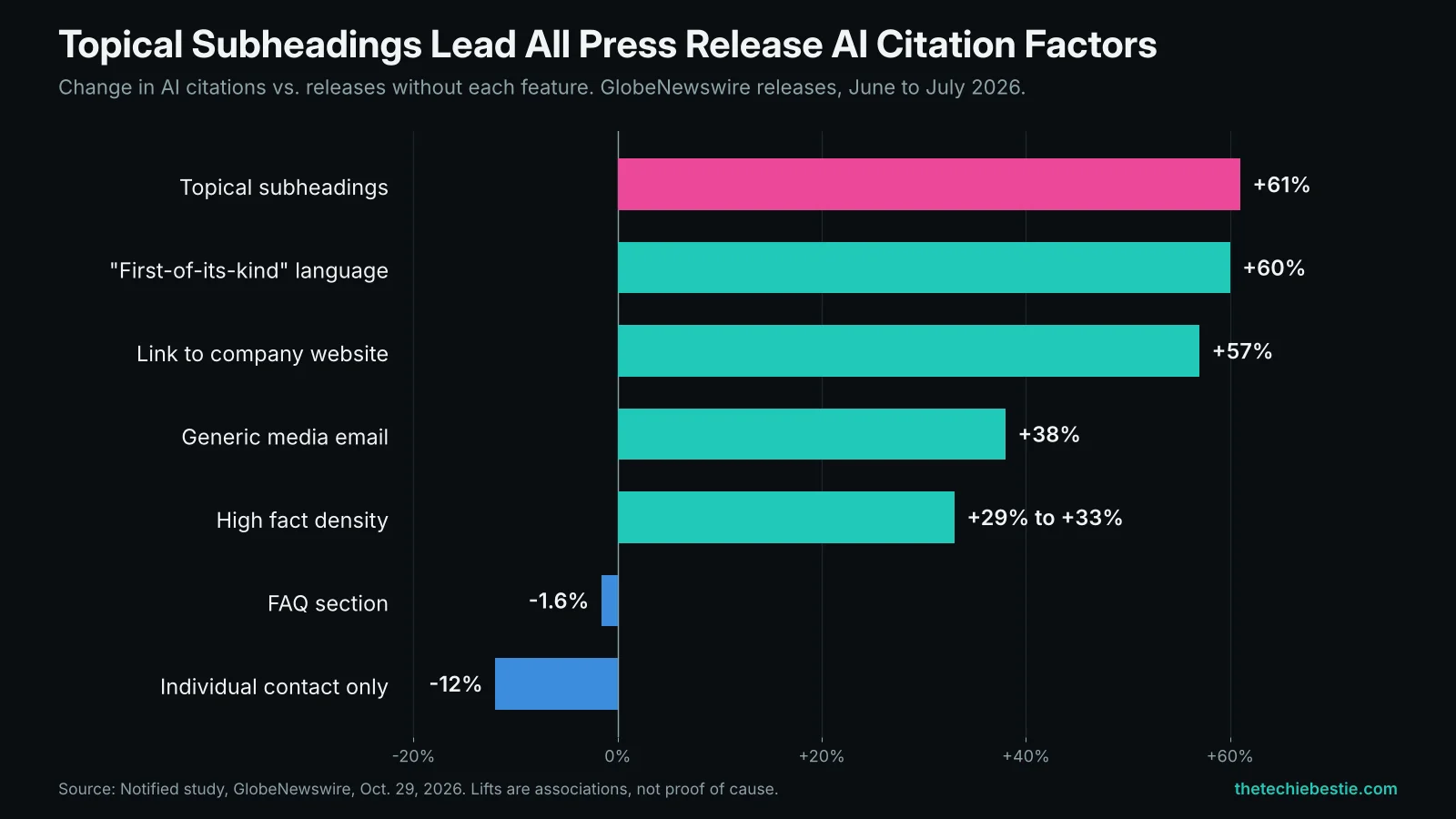
*Topical subheadings were tied to the biggest AI citation lift of any press release feature Notified measured.*
Change in AI citations for GlobeNewswire releases with each feature vs. without it, English-language releases, June to July 2026.
Data Table
| Press release feature | Change in AI citations |
|---|---|
| Topical (descriptive) subheadings | +61% |
| "First-of-its-kind" language | +60% |
| Link to the company's own website | +57% |
| Generic corporate media email | +38% |
| High fact density | +29% to +33% |
| FAQ section | -1.6% (neutral) |
| Individual contact only, no generic email | -12% |
Clear subheads did more for AI citations than any other change, and they cost nothing to write.
Chart: AI Engines Now Cite Press Releases Longer
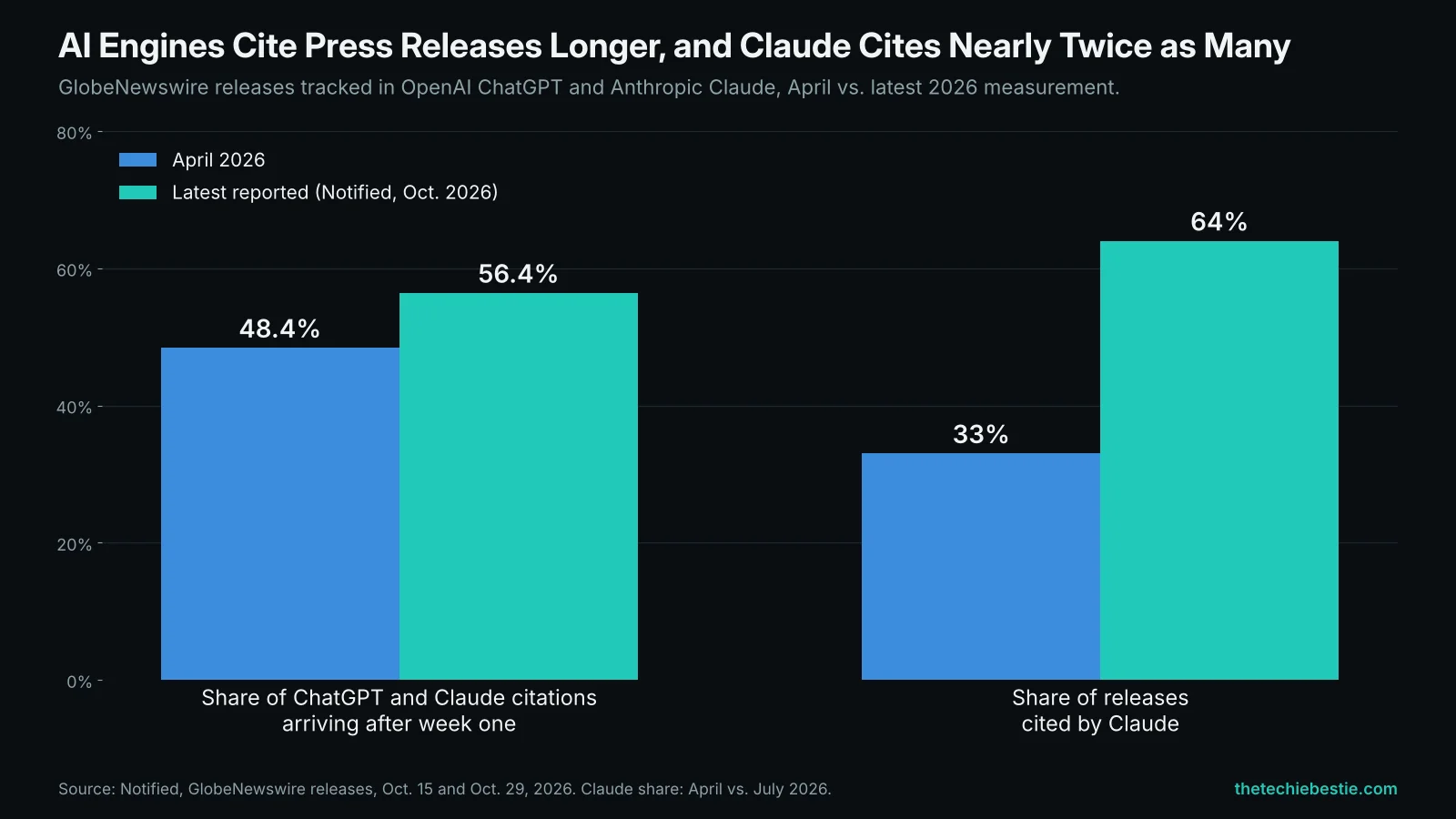
*AI engines keep citing press releases well past launch week, and Claude now cites nearly twice as many as it did in April.*
GlobeNewswire releases tracked in OpenAI ChatGPT and Anthropic Claude, April 2026 vs. the latest figures Notified reported in October 2026.
Data Table
| Metric | April 2026 | Latest reported |
|---|---|---|
| Share of ChatGPT and Claude citations arriving more than a week after publication | 48.4% | 56.4% |
| Share of releases cited by Claude | 33% | 64% (July 2026) |
| Median time to first citation, ChatGPT | Not reported | 1.2 hours |
| Median time to first citation, Claude | Not reported | 46 hours |
Your press release has a shelf life now. More than half of its AI citations show up after the news cycle moves on.
Old Press Release vs. GEO-Ready Press Release
Most B2B releases I audit still follow the wire template from 2010. They have one headline, a dateline, five dense paragraphs, a quote, and a boilerplate. That format was built for journalists skimming an inbox, not for AI engines pulling one clean passage to cite.
Comparison Chart
| Element | Old wire template | GEO-ready press release |
|---|---|---|
| Subheads | None, or "About the Company" only | A topical subhead every two or three paragraphs |
| Facts | Adjectives like "leading" and "innovative" | Dated numbers, named customers, and named products |
| Links | Homepage in the boilerplate | A deep link to the matching page on your site |
| Media contact | One person's name and email | A shared press inbox, plus a person if needed |
| Claims | Vague "first" or "only" language | A provable "first" claim with the proof in the next sentence |
| Shelf life | Treated as a one-day announcement | Mirrored on your own newsroom and tracked for weeks |
This matters most for B2B brands that run PR and SEO as separate teams. Here is why GEO for PR is now one job:
- ●Wire copies multiply your source. A single GlobeNewswire release gets republished on partner news sites, which gives AI engines more places to find the same facts.
- ●Citations arrive after the PR team moves on. If 56.4% of citations come after week one, the release keeps shaping AI answers about your brand during the weeks nobody is watching it.
- ●Claude is catching up fast. Claude cited nearly twice the share of releases in July that it did in April, so a ChatGPT-only tracking plan misses a growing engine. My five-engine comparison breaks down where each one pulls from.
How to Write a Press Release That Gets Cited by AI in 6 Steps
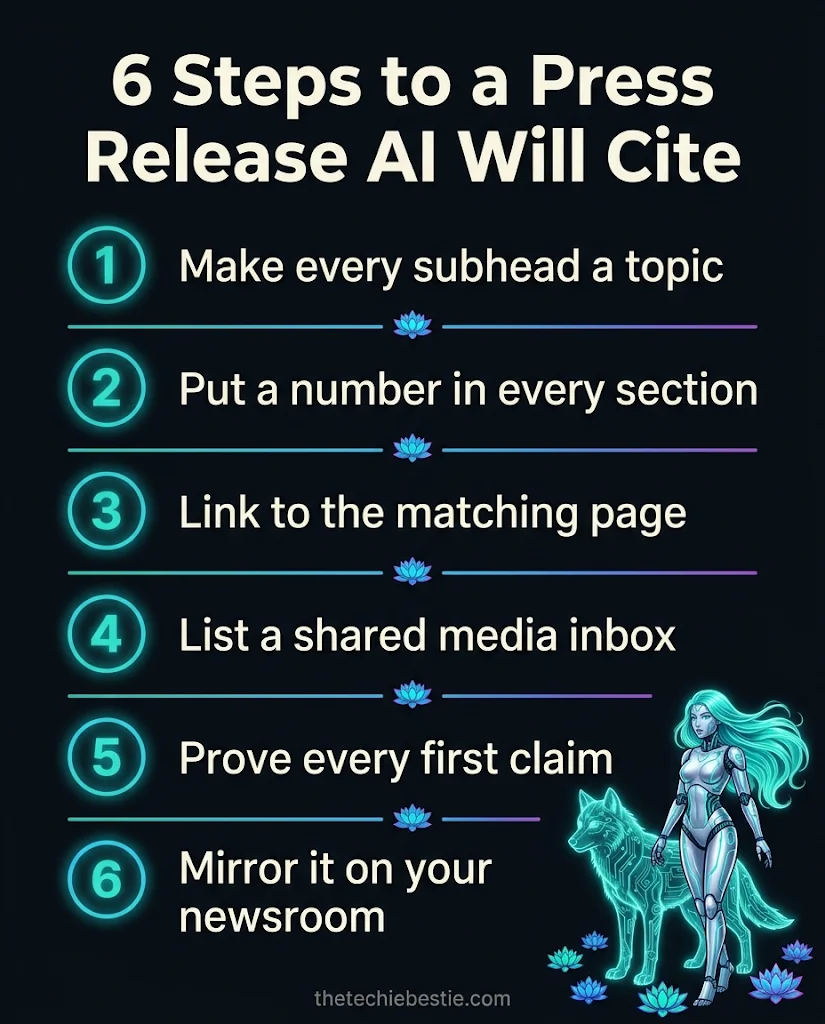
- 1.Turn every subhead into a topic. Swap "Highlights" for something like "Invoice Processing Time Fell 40% for Mid-Market Customers." A descriptive subhead tells AI engines exactly what the next passage answers.
- 2.Put a number in every section. Use dated figures, named customers, and named products instead of adjectives. Fact density was tied to up to 33% more citations.
- 3.Link to the matching page on your site. Point to the product, pricing, or research page the release is about, not just the homepage. Releases with a link home were tied to 57% more citations.
- 4.List a shared media inbox. Use press@ or media@ alongside any named contact. A person-only contact was tied to 12% fewer citations.
- 5.Use "first" claims only when you can prove them. Put the proof in the very next sentence, with a source or date. A false "first" can get your brand corrected in public by the same engines you want citing you.
- 6.Mirror the release on your own newsroom with schema. Publish it on your site with NewsArticle structured data and follow Google's guidance for AI features. Then check ChatGPT, Claude, Perplexity, and Google AI Mode at day 1, day 7, and day 30.
Want me to run this checklist on your last three releases? Book a strategy call or see packages and pricing. If you want the brand side of this, read How to Get ChatGPT to Recommend Your Brand next.
Key Takeaways
- ●Notified's October 29, 2026 study tied topical subheadings to 61% more AI citations for press releases.
- ●A link to your own site (57%), a generic media email (38%), and high fact density (29% to 33%) were also tied to more citations.
- ●56.4% of ChatGPT and Claude citations arrived more than a week after publication, up from 48.4% in April 2026.
- ●Claude cited 64% of releases in July 2026, up from 33% in April, so track more than one engine.
- ●The findings are associations, not proof of cause, but every fix is free and fast to apply.
Frequently Asked Questions
Do press releases get cited by ChatGPT and Claude?
Yes. Notified tracked more than 850,000 AI citation events tied to GlobeNewswire releases in 2026. Median time to a first citation was 1.2 hours in ChatGPT and 46 hours in Claude. Claude cited 64% of releases in July 2026, up from 33% in April 2026.
What makes a press release more likely to be cited by AI?
In Notified's October 2026 study, topical subheadings were tied to 61% more AI citations. Linking to the company's own website was tied to 57% more, a generic media email to 38% more, and high fact density to 29% to 33% more. The study reports these as associations, not proven causes.
How long do AI engines keep citing a press release?
Longer than most PR teams expect. Notified found that 56.4% of ChatGPT and Claude citations to GlobeNewswire releases arrived more than a week after publication, up from 48.4% in April 2026. A release keeps shaping AI answers about your brand for weeks after launch.
Should I add an FAQ section to my press release for AI visibility?
Not for the release itself. Notified found FAQ sections in press releases were roughly neutral, at minus 1.6% in AI citations. Put your effort into topical subheadings, specific numbers, and a link to the right page on your site. Save FAQs for your blog and product pages.
How big was the Notified press release AI citation study?
Notified's methodology describes 26,670 English-language GlobeNewswire releases from June and July 2026, plus comparison groups, and more than 850,000 citation events. The announcement headline rounds this to 25,000+ releases and nearly 1 million citations. Treat the sample size as approximate and the lifts as correlations.