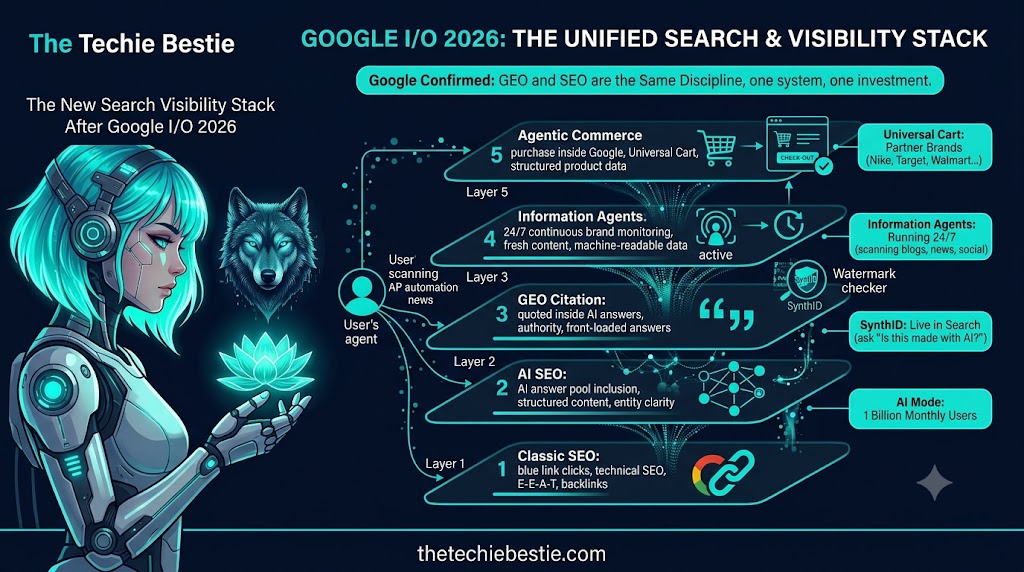
Before Google I/O 2026, your audience searched for answers.
After Google I/O 2026, their AI agents search on their behalf.
At Google I/O 2026 on May 19, Google announced information agents that continuously scan the web after a user's initial query and send back an intelligent, synthesized update capable of taking action. A user tells the agent what they care about, AP automation news, B2B SaaS content strategy, restaurant local SEO, and the agent monitors blogs, news sites, and social platforms 24/7, delivering synthesized updates without the user running another search.
The Agent Layer Is a New Visibility Surface, Not a New Strategy
Google has explicitly said that being crawlable, indexed, and producing useful content is still the baseline. What these announcements are expected to do is remove the remaining margin for mediocrity.
The brands that win in the agent layer are the same ones that win in traditional search and AI citations. The inputs are identical: fresh structured content, entity clarity, topical authority, and consistent publishing cadence. What changes is the urgency and the stakes.
The May 2026 Core Update, which launched May 21, simultaneously with I/O, makes this week's AI visibility audit urgent, not optional. Brands cited inside AI Overviews reportedly earn 35% more clicks than non-cited competitors. Branded queries see an 18% CTR lift under AI Overviews.
What Information Agents Actually Look At
Information agents continuously scan blogs, news sites, social posts, real-time finance, shopping, and sports data. A user specifies what they want to monitor. The agent reasons across everything it finds and delivers a synthesized update at exactly the right moment.
For B2B brands and service businesses, this changes the content question from "what should I rank for" to "what should my audience's agent find when it checks my domain this week."
The agent-readable content signals confirmed from I/O 2026:
- ●Fresh publication dates visible on every page. Agents deprioritize undated content. If your pages do not surface a publish or update date, agents treat them as stale.
- ●Named entities throughout every post. Agents reason across named tools, platforms, companies, and people. Generic content with no specific nouns is harder to synthesize and cite.
- ●Accurate, current data. Agents scan for changes related to a user's specific question. Outdated statistics and expired content surface to users as noise, not signal.
- ●Machine-readable structure. Clear H2 headings phrased as questions. Tables where comparisons exist. Short sentences. FAQs with direct answers. This is the same structure that earns traditional AI citations, and it is exactly what agents extract from.
- ●Consistent publishing cadence. If your site has not published anything fresh in the past 7-10 days, an agent monitoring your topic area will not find you in its current scan cycle.
What Agent-Readable Content Looks Like vs. What Most Sites Publish
| Signal | Agent-Readable (Earns Visibility) | Typical B2B Site Today |
|---|---|---|
| Publish date | Visible on every page | Missing on most pages |
| Named entities | 5+ per post (tools, people, platforms) | Generic language, no specifics |
| Publishing cadence | 2-3x per week | 1-2x per month |
| Content freshness | Updated within 90 days | Many pages 12-24+ months old |
| FAQ sections | Every post, direct Q&A format | Rare, buried in long prose |
| Data tables | At least 1 per post | Absent from most posts |
| llms.txt file | Present at root domain | Not yet implemented by 95%+ of sites |
Brands with strong structured data, expert-led content, accurate product feeds, and consistent information across the web are likely to benefit most from the agentic shift.
Universal Cart Just Changed Commerce Inside Google Forever
Universal Cart is Google's agentic shopping hub that works across Google Search, Gemini, YouTube, and Gmail. A user can add a product from any of those surfaces and manage everything in a single unified cart. The moment a product is added, Universal Cart works in the background finding deals, tracking price drops, providing price history, and sending stock alerts.
With Universal Cart spanning Search, Gemini, YouTube, and Gmail, and agents gaining the ability to make purchases and monitor activity across all of those surfaces, Google is building toward owning as much of the discovery-to-purchase funnel as possible.
Universal Cart launches on Google Search and Gemini in the US this summer. YouTube and Gmail support follow. UCP-powered checkout is expanding to Canada and Australia, with the UK to follow.
AI Max Is Now Out of Beta, and DSA Is on a Deadline
AI Max exits beta with a confirmed 7% conversion lift and forces a September 2026 migration for every Dynamic Search Ads account. If you are running DSA campaigns for yourself or any client, the September deadline is not optional. Set a calendar reminder now.
The September migration matters for content strategy because AI Max campaigns depend on page quality, structured data, and clear service descriptions to generate accurate ad targets. The same page that earns AI Mode citations and information agent visibility also drives AI Max campaign performance. One content investment, multiple returns.
The Attribution Problem Nobody Is Talking About
Information agents and agentic checkout create conversions with no session, no UTM, and no trackable click path. Ranking number one in Google no longer means you appear in the answer. The rules for SEO visibility have changed.
The full user journey now happens inside Google. Users can move from initial query to research to purchase intent without generating a single referral click to a publisher or brand site.
Your GA4 AI Assistant channel, launched May 13, captures AI referral clicks when a user actually clicks through. It does not capture the sessions where a user's agent synthesized your content, surfaced your brand in an update, and triggered a branded search or direct navigation days later. That attribution gap will grow as information agents scale.
The tracking framework that matters in H2 2026:
- ●Branded search volume trend (GSC), the leading indicator of agent-driven brand recognition
- ●AI Assistant channel traffic and conversion rate (GA4, already live)
- ●Direct traffic trend, agents who do not click through but do drive brand recall
- ●Revenue by channel, not sessions by channel, AI traffic converts at 15.9% despite low volume
FAQ, Google I/O 2026 Agentic Search and Commerce
What are Google Information Agents and when do they launch?
Information agents are background AI features within Google Search that run 24/7 on a user's behalf. A user describes what they are looking for and the agent continuously scans the web for matches and delivers synthesized updates. They roll out to Google AI Pro and Ultra subscribers in the US during summer 2026.
Do information agents replace the need for SEO?
No. Google has explicitly said that being crawlable, indexed, and producing useful content is still the baseline. Information agents use the same web Google's crawlers index. Strong SEO is the prerequisite for agent visibility, not an alternative to it.
What is Universal Cart and who can use it?
Universal Cart is a unified shopping cart that works across Google Search, Gemini, YouTube, and Gmail. It launches in the US this summer. UCP-powered checkout is expanding to Canada and Australia with the UK to follow.
How do I make my content visible to information agents?
Fresh publish dates, named entities, consistent 2-3x weekly publishing cadence, direct FAQ sections, data tables, and an llms.txt file at your root domain are the confirmed agent-readability signals from I/O 2026 guidance.
Does Universal Cart affect local businesses?
Yes. Agentic booking is expanding to local experiences and services. If Google's AI can help customers find and book local service providers, incomplete or inaccurate business data becomes a direct lead leak.
Start Building for the Agent Layer Now
The information agent rollout starts this summer. The brands that structure their content, publishing cadence, and local data for agent readability now will have a compounding visibility advantage by Q4 2026. The brands that wait will spend Q1 2027 catching up.
The Techie Bestie content strategy services build agent-ready content systems for B2B brands in fintech, SaaS, construction, and restaurants who cannot afford to be invisible to their audience's AI agents. Read more on The Techie Bestie blog or book a strategy call before your competitors get there first.