Most brands building an AI search strategy are optimizing for an abstraction.
They are spreading content effort evenly across ChatGPT, Perplexity, Gemini, and Claude. They are building llms.txt files for Google. They are tracking AI visibility across five platforms simultaneously without enough data to act on any of them.
The Previsible 2026 State of AI Discovery Report, based on 6.77 million LLM-driven sessions across 166 websites over 19 months, cuts through all of it with a single number.
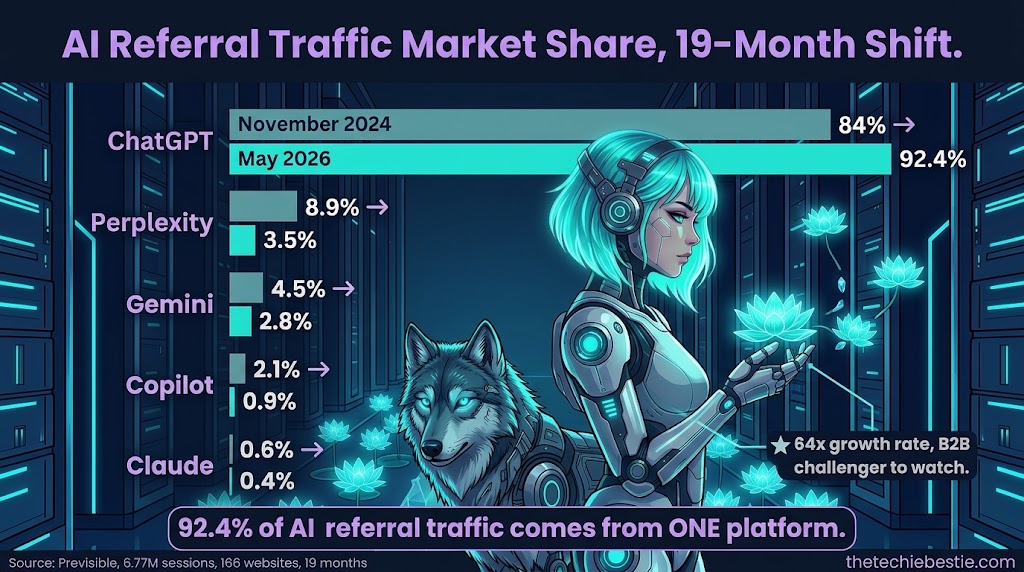
ChatGPT commands 92.4% of all trackable LLM referral traffic, growing 12.8x over 19 months with no sign of slowing. It is the only LLM sending meaningful referral volume at scale.
If you are treating AI search as a multi-platform problem, you are solving the wrong problem. Here is what the full dataset shows and exactly what to do about it.
The Consolidation Story Nobody Expected
Twelve months ago, the conventional wisdom was that AI referral traffic would fragment across platforms. ChatGPT would dominate briefly, then Perplexity would carve out a research niche, Gemini would leverage Google's distribution, and Claude would grow on enterprise adoption. The traffic would spread.
It did not.
When Previsible last published in December 2025, ChatGPT held roughly 84% share, followed by Perplexity at 8.9%, Gemini at 4.5%, Copilot at 2.1%, and Claude at 0.6%. Six months later, the field has collapsed toward the leader. ChatGPT commands 92.4% of all LLM referral sessions and is still gaining relative share.
Monthly LLM sessions rose from 65,249 in November 2024 to 644,478 in May 2026, a 9.9x increase, and ChatGPT accounts for virtually all of that growth.
The surprise is not at the top. It is who is moving underneath. Claude grew 64x, from 133 sessions in November 2024 to 8,528 in May 2026, and overtook Perplexity in March 2026 for the first time. That is a 6,300% growth rate from a tiny base. Claude is not a threat to ChatGPT's dominance yet, but it is the platform to watch for content professionals and B2B brands specifically.
Sessions fell 50% in one month in November 2025, driven almost entirely by ChatGPT referrals dropping from 448,412 to 213,345, because the model began favoring Wikipedia and Reddit. One vendor's product decision can halve your AI traffic overnight. Plan for the volatility.
This volatility is the most underrated risk in AI content strategy. A single model update at OpenAI can redirect referral traffic away from your domain category in a matter of days. Brands with strong traditional SEO foundations, diversified traffic sources, strong direct and branded search volume, email lists, absorb these shocks. Brands that have pivoted entirely to AI optimization have no floor.
What AI Referral Traffic Actually Does When It Arrives
The Previsible data answers a question most AI traffic studies skip: what happens after the click?
Brands recommended by ChatGPT in its answers receive 2.5 times more website visits within seven days than comparable brands without a recommendation, based on a Similarweb US desktop clickstream panel from July 2025 to January 2026.
The conversion quality reinforces this. AI traffic converts at 4.4x to 23x the rate of organic search. ChatGPT ecommerce traffic converts 31% higher than non-branded organic. AI-referred visitors spend 68% more time on sites.
These are not incremental improvements. They represent a fundamentally different intent profile. AI-referred visitors have already received a synthesized answer from a platform they trust. They clicked through because the answer was not enough, they wanted depth, proof, or context. That intent signal is worth more per session than almost any other acquisition channel.
The IT industry experiences the highest AI-driven visit share at 2.8% of total traffic. Legal saw the fastest year-over-year growth at 823%. Finance, healthcare, and consumer electronics follow with 40-55% AI-influenced purchase rates.
For my client verticals specifically, fintech and B2B SaaS are operating in categories where AI-influenced purchase rates are already reshaping the discovery layer. Construction and restaurant clients are earlier in the AI adoption curve, which means there is first-mover advantage available right now for local and regional businesses that structure their content before competitors do.
AI Referral Traffic Market Share, November 2024 vs. May 2026
| Platform | November 2024 | May 2026 | Change |
|---|---|---|---|
| ChatGPT | 84.0% | 92.4% | +8.4 pts |
| Perplexity | 8.9% | ~3.5% | -5.4 pts |
| Gemini | 4.5% | ~2.8% | -1.7 pts |
| Copilot | 2.1% | ~0.9% | -1.2 pts |
| Claude | 0.6% | ~0.4% | Flat, growing fast from a small base |
The market is not diversifying. It is consolidating. That changes the resource allocation math for every content team.
The Important Framing Most Coverage Misses
The Previsible data measures standalone LLM referral traffic. AI discovery inside Google's own results, including AI Overviews, almost certainly drives more AI traffic than all standalone platforms combined, but it operates on a different measurement paradigm.
This distinction matters enormously for strategy. The 92.4% number applies to traffic from ChatGPT.com, Claude.ai, Perplexity.ai, and similar standalone LLM platforms. It does not capture the impressions your content earns inside Google AI Mode and Google AI Overviews, which is what the new GSC Generative AI Performance Report measures.
Traditional organic search still drives roughly 31.9% of site sessions versus AI's 0.13%. Anyone telling you to fully pivot to AI optimization is selling you something.
The honest picture is this: organic search is still the dominant traffic channel by volume. AI referral traffic is growing 165x faster than organic search but from a much smaller base. The brands that win are not the ones abandoning SEO for AI optimization, they are the ones applying the same content quality and structure discipline to both surfaces simultaneously.
ChatGPT only activates its search feature on 34.5% of queries. Most responses still rely on training data alone. This means entity strength, how well AI models understand your brand, what you do, and who you serve, based on what they learned in training, is just as important as getting cited in real-time search results. Building brand authority that enters AI training data is a longer-term compounding strategy that complements citation optimization.
What to Actually Do With This Data
Concentrate your ChatGPT optimization, do not spread it.
If you have limited content resources, the data says to prioritize content that earns ChatGPT citations specifically. That means structured, front-loaded, expert-attributed content that directly answers the questions your buyers are asking inside ChatGPT. One platform commands 92.4% of the traffic. Act accordingly.
Build a volatility floor.
The November 2025 traffic cliff, where ChatGPT referrals dropped 50% in a single month due to a model change, is the most important risk signal in the report. Brands that have strong traditional organic traffic, direct traffic, email lists, and branded search volume absorbed that shock. Brands that had over-indexed on AI referral traffic as a primary channel felt it acutely. Diversification is not a hedge against AI search success. It is the foundation that makes AI search success durable.
Watch Claude, not Perplexity.
Every AI search think piece of 2024 said Perplexity was the platform to watch as ChatGPT's primary challenger. The data says Claude overtook Perplexity in March 2026. Claude's 64x growth rate over 19 months, from 133 sessions to 8,528, is the steepest growth curve in the dataset. Its user base skews heavily toward B2B, research, and professional use cases. For brands in fintech, B2B SaaS, and professional services, Claude is the second platform worth tracking now.
Treat AI recommendations as a purchase intent signal.
An AI recommendation is not an awareness signal that may eventually convert. It is a direct purchase intent trigger. The 2.5x visit lift within seven days of a ChatGPT recommendation, combined with the 15.9% conversion rate data from GA4 AI Assistant tracking, means AI-referred visitors are your highest-quality inbound traffic. They should land on pages built to convert, not on generic blog posts. Product pages, case studies, services pages, and comparison content should be structured for AI citation specifically, not just blog posts.
FAQ, ChatGPT AI Traffic Dominance, 2026
How was the 92.4% ChatGPT market share figure calculated?
Previsible analyzed 6.77 million LLM-driven sessions across 166 GA4 properties from November 2024 through May 2026, spanning SaaS, ecommerce, finance, legal, health, insurance, education, and publishing verticals. ChatGPT sessions accounted for 92.4% of all attributable LLM referral sessions.
Does the 92.4% figure include Google AI Overviews traffic?
No. The Previsible study measures standalone LLM referral traffic from platforms like ChatGPT.com, Claude.ai, and Perplexity.ai. Google AI Overviews and AI Mode traffic operates on a different measurement paradigm and is excluded from the dataset. Use the new GSC Generative AI Performance Report for Google AI impression data.
Is Claude worth optimizing for?
Yes, specifically for B2B, professional services, and research-heavy verticals. Claude grew 64x over 19 months and overtook Perplexity in March 2026. Its traffic volume is still small, but its growth trajectory and user profile, predominantly B2B and professional, make it the second platform worth tracking for brands in fintech, SaaS, and legal.
Can ChatGPT traffic drop suddenly?
Yes. In November 2025, ChatGPT referrals dropped 50% in a single month due to a model update that shifted sourcing toward Wikipedia and Reddit. Traffic recovered by December. Plan for this volatility by maintaining strong traditional organic and direct traffic channels as a floor.
What converts better, ChatGPT traffic or Google organic traffic?
ChatGPT referral traffic converts at 15.9% versus Google organic's average of approximately 2.4%. ChatGPT ecommerce traffic specifically converts 31% higher than non-branded organic. AI-referred visitors spend 68% more time on site.
Should I stop optimizing for Perplexity and Gemini?
Do not abandon them, but do not over-resource them relative to ChatGPT. Perplexity dropped from 8.9% to approximately 3.5% of AI referral share in six months. Gemini dropped from 4.5% to approximately 2.8%. The consolidation is real and continuing. Allocate accordingly.
Stop Optimizing for an Abstraction
The 92.4% number is the most actionable data point in AI search strategy right now. It does not mean ignore every other platform. It means stop treating AI search as a five-platform problem when one platform commands almost all of the traffic.
Structure your content for ChatGPT citation first. Build your GSC Generative AI report baseline for Google AI impression tracking. Watch Claude's growth for B2B and professional verticals. Maintain your traditional organic foundation as the volatility floor.
That is the full stack. One number clarifies the priority order.
My content strategy services build content systems engineered for the platforms that actually send traffic, not abstractions. Read more on The Techie Bestie blog or book a strategy call to audit where your content sits in the AI discovery stack.