AI search is changing faster than most marketers can document it. In the past month alone, the biggest winners have not just been the brands with the best rankings. They have been the brands, creators, and platforms that AI systems trust enough to cite.
If you are still treating SEO, GEO, and AI visibility like separate channels, you are already behind. The new playbook is distribution, authority, and machine-readable expertise across your website, LinkedIn, community content, and supporting assets. If you are new to the shift from SEO to GEO, start with The End of SEO as We Know It: A Definitive Guide to GEO.
Why the Last 30 Days Matter for SEO and AI Search
The last month revealed a pattern that is too important to ignore. AI systems are increasingly citing sources based on authority, freshness, and clarity, not just old-school ranking position. New research shows LinkedIn has surged into one of the most influential citation sources for professional queries, while Google AI Mode continues to expand how search results are displayed and measured.
For marketers, that means your content strategy needs to serve two audiences at once:
Human readers and AI retrieval systems. That is where the monetization opportunity lives.
LinkedIn Is Now a Serious SEO and AI Visibility Channel
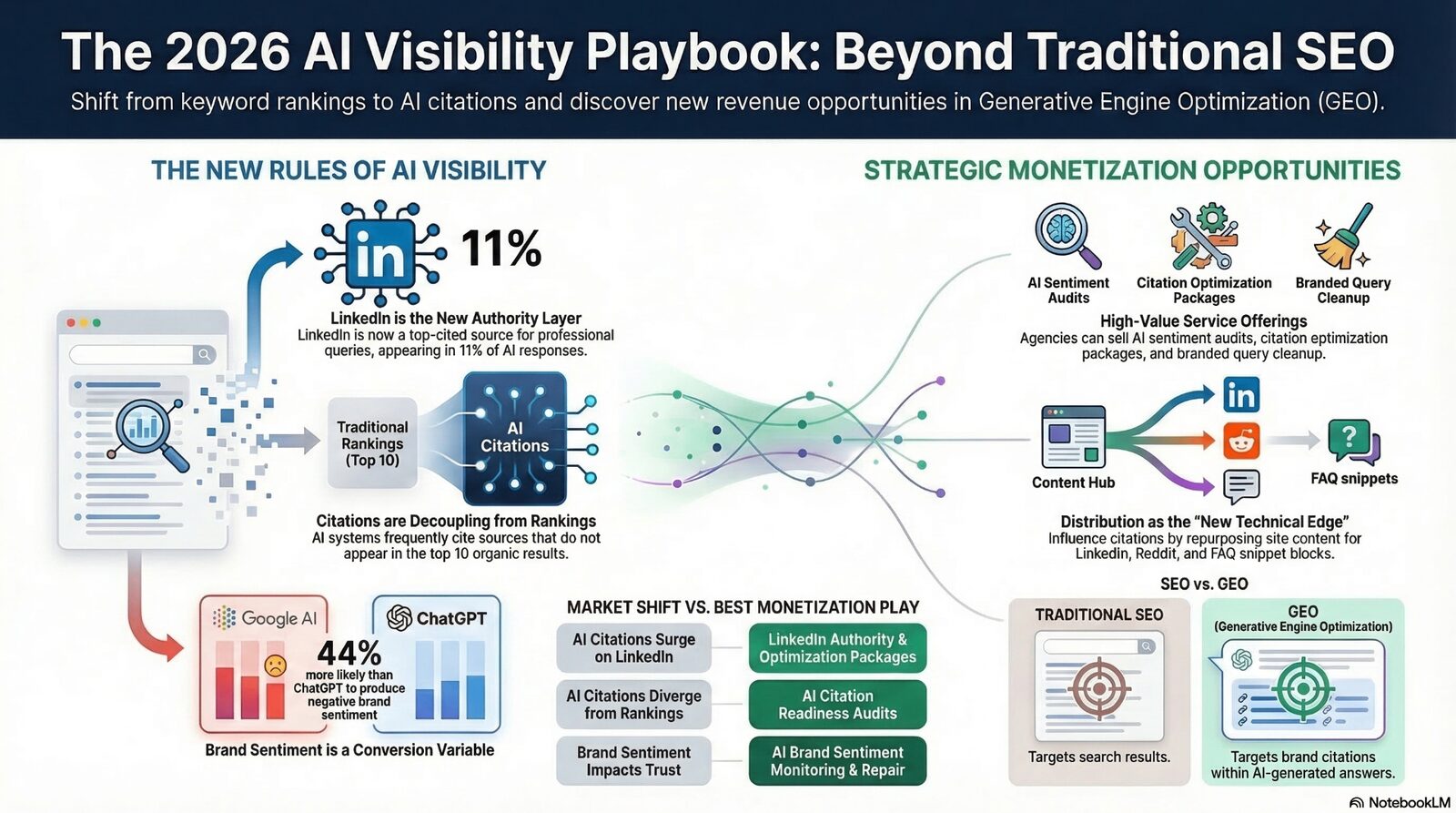
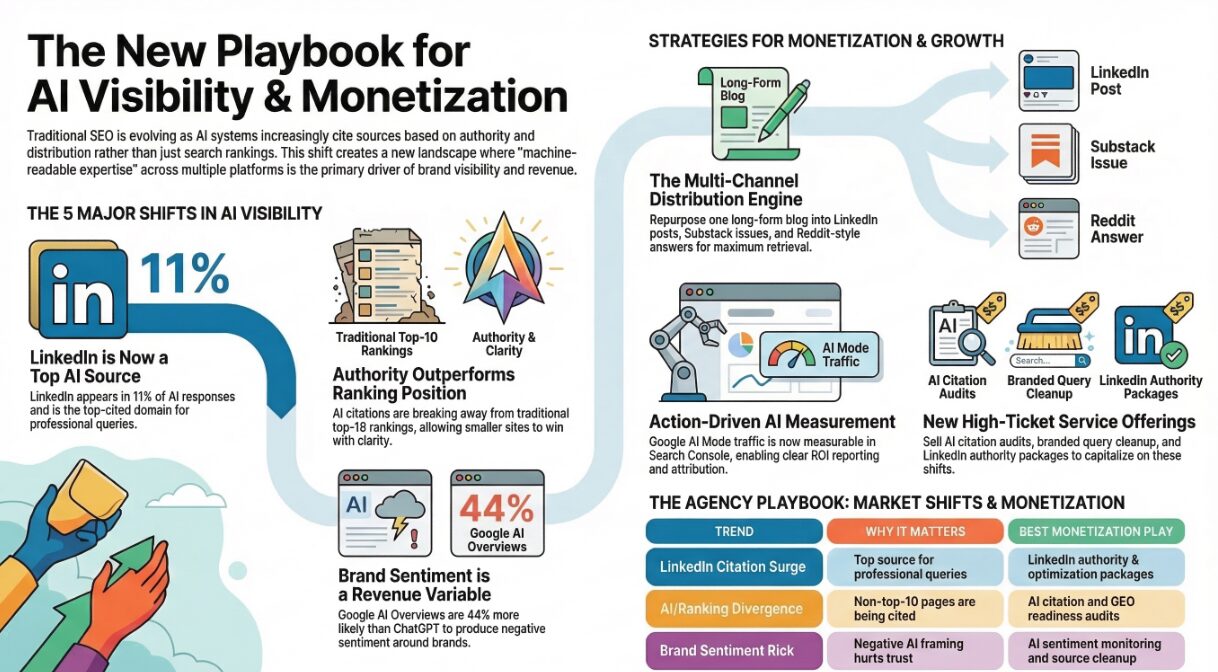
For years, LinkedIn was treated as a distribution channel. Now it is also a source layer for AI answers. Profound found LinkedIn is now the top-cited domain for professional queries across major AI platforms, while Semrush found LinkedIn appearing in 11 percent of AI responses on average in its dataset.
How to Monetize This Shift
You can turn LinkedIn into a revenue channel by offering executive thought leadership content, AI citation optimization packages, expert post repurposing, LinkedIn profile and article optimization, and website-to-LinkedIn syndication systems.
What is the fastest way to improve AI visibility for a B2B brand? The fastest way is to combine a strong website with public expert content on highly cited platforms like LinkedIn, where AI systems increasingly pull professional source material.
AI Citations Are Breaking Away from Traditional Rankings
One of the biggest misconceptions in 2026 is that AI visibility is just SEO with a new label. It is not. Research summaries published this week show the overlap between AI citations and classic top-10 rankings is weakening, which means your content can be cited even when it is not the top organic result. For a deeper dive into the trends shaping visibility this year, check out The 5 Game-Changing SEO Trends You Need to Know in 2026.
What This Means for Smaller Sites
Smaller brands and personal brands can now win with sharp, original POV, strong author identity, clear definitions, factual structure, and multi-channel distribution. That is great news for independent consultants, agencies, and niche publishers. This is exactly the kind of advantage explored in The Lone Wolf Advantage: Why One Expert Beats a Whole Agency in the AI Era.
Do you need to rank number one in Google to be cited by AI? No. Recent data suggests many AI citations now come from pages that are not top-10 organic results, which means authority and clarity can outperform raw ranking position in some AI environments.
Google AI Mode Is Becoming More Action-Driven
Google's AI search experience is moving closer to decision support and transactions. Recent reporting highlighted updates to AI Mode link formats and shopping-related behavior, while Google documentation confirms AI Mode traffic is now counted in Search Console totals.
That matters because marketers can no longer treat AI search like a top-of-funnel toy. It is becoming a measurable acquisition surface.
Best Content Plays for This Trend
Create content that answers how to track AI Mode traffic, how AI search affects conversion rates, what CRO looks like in answer-engine interfaces, and how to prepare category pages for AI-assisted discovery.
Brand Sentiment in AI Answers Is Now a Revenue Variable
If AI describes your brand poorly, that can hurt conversions even when you are cited. BrightEdge data reported this week found Google AI Overviews were 44 percent more likely than ChatGPT to produce negative sentiment around brands in the dataset analyzed.
That means reputation management is no longer just reviews and PR. It is now AI answer monitoring, source cleanup, citation shaping, and stale-content correction.
This Is a Massive Service Opportunity
Agencies and consultants can sell AI sentiment audits, branded query cleanup, FAQ repair, publisher and source correction strategies, and review and trust content frameworks.
Distribution Is the New Technical Edge
Social and community content now influence AI citations more than many brands realize. Social media's share of AI citations has climbed past 9 percent, and platforms like Reddit, LinkedIn, YouTube, and Wikipedia continue to play an outsized role in how AI systems answer nuanced questions.
This is why the future of SEO is not just publishing. It is distributing retrievable proof. For small and mid-sized businesses looking to stay ahead of this curve, Why Agentic Engineering Is the SMB Game-Changer You Cannot Afford to Ignore in 2026 breaks down the automation angle.
The Best Content Engine Right Now
The most effective structure looks like this: publish the long-form blog on your site, turn key sections into LinkedIn posts, convert analysis into a Substack issue, answer objections in Reddit-style language, and create FAQ blocks and definition boxes for snippet capture.
Where the Biggest 2026 AI Visibility Opportunities Are
| Trend | What changed | Why it matters | Best monetization play |
|---|---|---|---|
| LinkedIn citations surged | LinkedIn is now a top AI-cited source for professional queries | Faster expert visibility | LinkedIn authority packages |
| AI citations diverged from rankings | AI does not only cite top-10 pages | Smaller brands can compete | AI citation audits |
| Google AI Mode became more measurable | AI Mode traffic counts in Search Console totals | Easier reporting and attribution | AI search reporting retainers |
| Brand sentiment in AI matters more | Negative framing can shape buyer trust | Visibility alone is not enough | AI brand sentiment monitoring |
| Social/community sourcing increased | Reddit, YouTube, LinkedIn are shaping answers | Distribution beats isolated publishing | GEO distribution retainers |
Best Tools for People Who Want the Edge Early
Here are a few lesser-known tools worth testing right now: GEO Analyzer for content-level AI citation readiness, Gego for scheduled cross-LLM tracking, AI Chat Watch for open-source brand mention tracking, GetCito for AI answer visibility monitoring, and AgentLinter for auditing agent workflows and prompt risk in AI-first teams.
How to Start Winning This Month
You do not need a giant team. You need a better system. Start here: turn one strong blog into five distributed assets, publish original expert takes on LinkedIn, tighten author bios and entity signals, add definition blocks and FAQ sections, monitor how AI tools describe your brand, and build content that is easy to cite, not just easy to skim.
Frequently Asked Questions
What is the difference between SEO and GEO?
SEO focuses on improving visibility in traditional search results. GEO focuses on improving how often your brand or content is cited or surfaced inside AI-generated answers.
Can LinkedIn really help AI visibility?
Yes. Recent third-party data shows LinkedIn has become one of the most-cited sources in AI answers and the top-cited domain for professional queries.
Do I still need a blog if AI pulls from social platforms?
Yes. Your blog remains your owned authority hub. The winning strategy is to pair your website with public distribution on highly cited platforms like LinkedIn and community channels.
What kinds of content are most likely to win snippets and citations?
Clear definitions, concise answers, structured FAQs, comparison pages, and expert commentary with fresh examples are all strong formats for snippet capture and AI citation.
What should marketers measure now that AI search is growing?
Track branded mentions, cited URLs, sentiment, assisted traffic from AI experiences, LinkedIn authority growth, and Search Console changes related to AI Mode.
Ready to future-proof your visibility strategy? Explore our full range of services or view transparent pricing to get started with The Techie Bestie.